
Trustless, borderless, immutable. Cryptocurrency as we know it wouldn’t exist without cryptography. And one of its use cases is blockchain encryption methods.
Deciding on one is the first step to achieving the three most important goals in crypto: security, decentralization, and scalability of the blockchain trilemma. So far, there’s no absolute solution that gets all three right. Which is why there are so many blockchains, each with different encryption methods.
While they might sound abstract and technical, we use them all the time with crypto wallets and payments.
What Is Encryption? (And How It Differs from Hashing)
Encryption refers to computing methods that transform plain text into unreadable content or ciphertext. This “cipher” consists of a message, a code word (or key), and a pattern. This pattern can be as complex as letter-position swaps, math equations, or substitution tables. The goal is to send the message from party A to B without revealing it to other parties.
It might sound simple because you only need to share the key with both users. That’s what’s called symmetric encryption. It’s a key shared with every user you want to get the message.
The problem is: the more people have this key, the easier it is for the wrong person to find it. It’s the opposite of decentralization:
- Decentralized means that you can’t control a system from a single entity. You need to control at least half of all “nodes” (users, devices, keys…)
- Symmetric encryption means that, because all use the same key, one compromised node is enough to compromise everything.
Imagine you share a Metamask wallet with nine trusted people, so you all use the same private key/seed phrase. Even if you all use it responsibly, there’s ten times more risk that someone outside the group finds it. Either by accident, fraud, or blockchain’s lack of privacy.
If you know the key, you can decrypt or revert the cipher.
To prevent this, there’s a second type: asymmetric encryption. It uses a complex math function to generate two linked keys. It’s slower than the alternative, and the logic behind it is beyond the scope of this post. (But you can check this video for a simple analogy)
It looks like this:
Message + Key1 = Ciphertext
Ciphertext + Key2 = Message
Where Key1 is shared and Key2 is secret.
And it basically means:
- There’s a public key that you share when sending the message and a private key you keep secret.
- The message recipient also has a public key to respond and a private key to decrypt your message.
- If you receive a message, you just need their public key and your private key to decipher it. If you send a message, the recipient needs your public key but not your private one.
- You cannot decipher messages only knowing both private keys (unless you spend ridiculous time and computer power on trial and error).
Similarly in crypto, you can see anyone’s wallet and transactions. But you can’t access or use those funds without the private key. It’s as secure as your ability to keep your key unknown.
Top 4 Most Used Encryption Methods
Every encryption method is either symmetric (one shared key) or asymmetric (a public and private key pair). The comparison table above gives you the quick view. The sections below explain how each one actually works and why it matters for blockchain specifically.
👉 Quick takeaway: AES-GCM is the go-to for encrypting data at rest. ECDSA and EdDSA are the standard for blockchain signatures. RSA remains valid for key exchange and certificates but requires 2048-bit minimum. Triple DES is deprecated — do not use it for new designs.
| Method | Type | Key Size | Speed | Still Recommended? | Best For |
|---|---|---|---|---|---|
| AES | Symmetric |
128,
192, or
256-bit
|
🟢 Very fast 🏆 Fastest encryption in table |
🟢 Yes Use AES-GCM mode |
Encrypting data at rest, wallet files, bulk data 🏆 Best for bulk data encryption |
| RSA | Asymmetric |
2048-bit minimum
|
⚠️ Slow |
⚠️ Yes, with caveats 2048-bit minimum required |
Key exchange, digital certificates, TLS handshakes |
| ECDSA / EdDSA | Asymmetric |
256-bitEquivalent to RSA-3072 |
🟢 Fast | 🟢 Yes |
Blockchain signatures, Bitcoin, Ethereum, TLS 🏆 Standard for blockchain signatures |
| Triple DES (3DES) | Symmetric |
112 or
168-bit effective
|
🔴 Very slow |
🔴 No — Deprecated Do not use for new designs |
⚠️ Legacy systems only Do not use for new designs |
The short version: AES and ECDSA are the workhorses of modern encryption. RSA still appears in TLS and certificate infrastructure. Triple DES is a museum piece. A fifth category is arriving fast: post-quantum algorithms, covered at the end of this article.
Which Encryption Method Should You Use?
The answer depends on what you are trying to protect.
Encrypting a file or wallet: Use AES-256-GCM. It is fast, quantum-resistant at this key size, and the current NIST standard for data at rest.
Signing a blockchain transaction: ECDSA or EdDSA. Both are fast enough for real-time use and produce compact signatures. EdDSA (used by Cardano, Monero, Polkadot) is slightly faster and avoids certain implementation pitfalls that affect ECDSA.
Sending an encrypted message to someone: RSA or ECDH for key exchange, then AES-GCM for the actual message content. Using RSA alone to encrypt large messages is slow and not recommended. The standard pattern is: RSA/ECDH to agree on a shared key, AES-GCM to encrypt the content.
Building something that needs to last 10 or more years: Factor in post-quantum migration. ML-KEM (Kyber) for key exchange and ML-DSA (Dilithium) for signatures are the NIST-standardized replacements. Plan for hybrid schemes during the transition period.
Anything involving Triple DES: Stop. Use AES-256 instead.
The 4 Methods in Detail
RSA
RSA is an asymmetric encryption method invented by three MIT computer scientists: Ronald Rivest, Adi, Shamir, and Leonard Adleman. It’s based on complex mathematics and while secure, it’s slower than other methods. In a nutshell, it works like this:
- Suppose you want to send a message from User A to B, but an omnipresent User C can see all data sent in between. The goal is to keep the information confidential between A and B.
- The RSA algorithm generates a public and private key for each. User A can share its public key and also see B’s public key. Neither of them ever knows nor shares each other’s private keys.
- According to RSA, it’s easy to multiply but hard to factorize large numbers. This creates a one-way equation that’s very difficult to revert. Thus, users can derive public keys from private ones without being reverted to private keys.
- First, the receiver user B generates his keys and shares the public one. User A uses User B’s public key to encrypt his message. After sending it, User B will use the private key to decrypt User A’s message.
- User C can steal the ciphertext and public key. But because they don’t have private ones, it’s unreadable.
In asymmetric encryption, using the same public key to revert ciphertext results in decryption failure.
RSA is used as the foundation of ECDSA, which is an improved and lighter version used for cryptocurrencies. Although a few use the original RSA (e.g., Hedera Hashgraph, HBAR), it helps understand the next method:
Elliptic Curve Digital Signature Algorithm (ECDSA)
ECDSA hits a practical balance of security and speed. A 256-bit ECDSA key provides roughly the same security as a 3072-bit RSA key, at a fraction of the computational cost. That is why Bitcoin, Ethereum, Ripple, Litecoin, BNB Chain, and Cosmos use it. Cardano, Monero, and Polkadot use EdDSA instead. EdDSA is faster and avoids the nonce-reuse vulnerability that has caused real-world ECDSA failures in the past.
Triple DES (3DES)
Triple DES (3DES) is the oldest method on this list. It applies the 1970s Data Encryption Standard three times in sequence, each pass using a different key. That approach did raise the cracking difficulty significantly compared to plain DES. It also tripled the encryption time.
The SWEET32 attack in 2016 exposed a practical collision vulnerability in 3DES’s 64-bit block size. NIST formally deprecated 3DES through all applications by 2023. No new system should use it.
It is included here for one reason: understanding why 3DES failed explains exactly what AES fixed. AES uses 128-bit blocks instead of 64-bit, which closes the SWEET32 attack surface entirely.
Advanced Encryption Standard (AES)
AES has not been cracked. It is the global standard for encrypting data at rest and in transit, used by the NSA, Bitcoin Core, and every HTTPS connection your browser makes today.
The key sizes matter. AES-128 offers 128 bits of security. AES-256 doubles that, and is recommended for high-sensitivity data. The block size is 128 bits regardless of key length, which is what closed the 64-bit vulnerability that killed 3DES.
For modern implementations, AES alone is not enough. The mode of operation matters just as much as the key size. AES-GCM (Galois/Counter Mode) is the current NIST-recommended approach. It provides authenticated encryption, meaning it verifies that data has not been tampered with during transit, not just that it is unreadable. Plain AES in CBC mode does not do this. AES-GCM is the mode behind TLS 1.3 and most modern HTTPS connections.
On Bitcoin Core, AES-256-CBC encrypts wallet files when you set a passphrase. The passphrase is the decryption key. No passphrase, no access.
Common Encryption Alternatives in Crypto
Encryption is just one part of cryptography, which is one of the many obfuscation techniques. To encrypt is to make information unreadable. To obfuscate is to make the meaning or information intent confusing or incoherent.
Blockchains use different obfuscation methods that can’t be classified as encryption but fulfill similar goals. Here are some of them:
ZK Proofs
Zero-Knowledge proofs are essential in Ethereum to remain efficient while decentralized. Given a problem or puzzle, ZK-proofs allows one user to verify that they know the solution, without revealing it to the user verifying it. This helps protect sensitive information like passwords, identities, or financial information.
For example, computers “know” when you entered the wrong or right password, even though the servers don’t store any. That’s because computers convert your input with a one-way function (irreversible) into asymmetric ciphertext. This cipher preserves the same patterns from the original information, which means that by comparing both, you’re going to find the same relationships.
Here’s a detailed analogy of how ZK Proof works.
Hashing
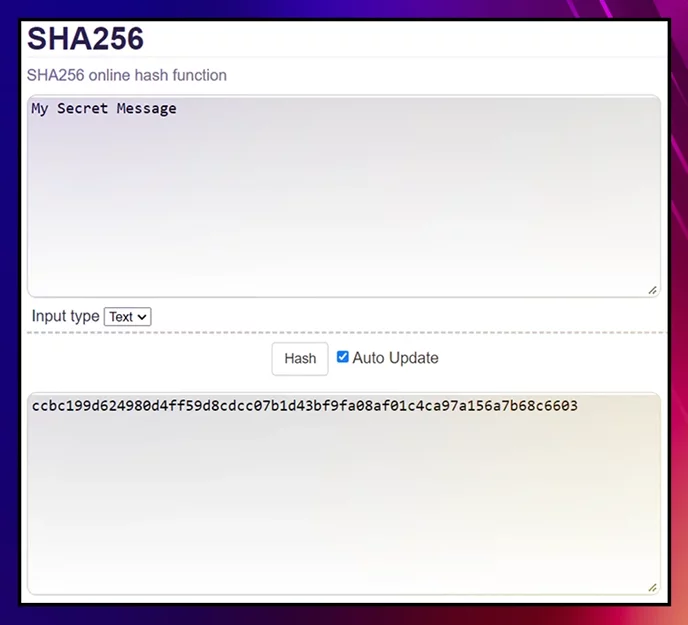
Encryption is a two-way method, either by using the same key or a private one. Hashing is a one-way method that takes block information and converts it to a fixed string of numbers and letters. Entering the same data generates the same hash, but reverting a hash to the same data requires years of trial and error. Arguably impossible.
No matter the algorithm, every coin with a blockchain uses hashing. Bitcoin’s is called SHA-256 and is a more complex version of this:
If we add just one space at the end of the message, it’s a completely different string:
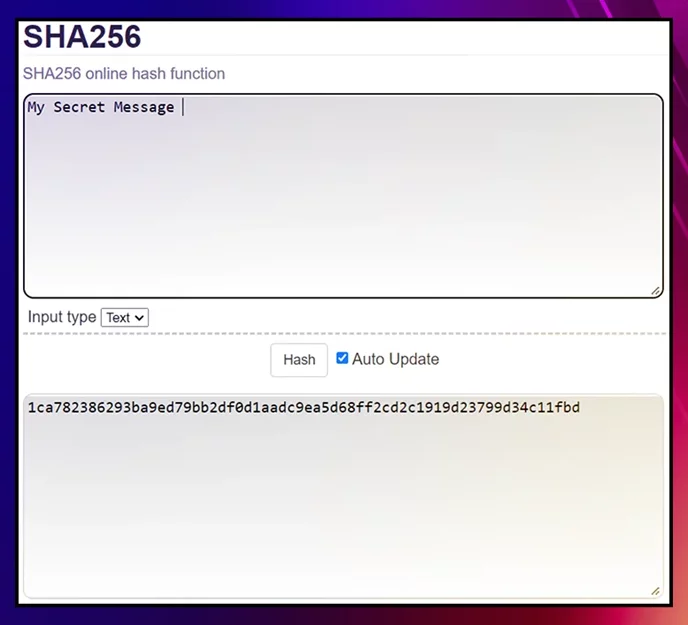
In order to add a new block to a cryptocurrency chain, this data block has to include the hash of the previous block.
Is Encryption Enough To Secure Blockchain?
It’s hard to imagine a secure blockchain that doesn’t use some encryption method. They’re essential for secure decentralization, just as it is for Internet browsing. But it’s not infallible.
Security in crypto involves more challenges beyond protecting information. Quantum computers are no longer a distant hypothetical. NIST published the first three post-quantum cryptography standards in August 2024: FIPS 203 (ML-KEM, based on Kyber), FIPS 204 (ML-DSA, based on Dilithium), and FIPS 205 (SPHINCS+). In March 2025, NIST selected HQC as a fourth-round candidate, providing a backup algorithm in case lattice-based methods face future vulnerabilities.
RSA and ECDSA, the two asymmetric methods this article covers, are both vulnerable to a sufficiently powerful quantum computer running Shor’s algorithm. AES-256 is considered quantum-resistant with its current key size, though AES-128 is not.
For most blockchain users today, this is not an immediate threat. For organizations handling sensitive long-lived data, migration planning has started now.
What Is Crypto-Agility and Why Does It Matter Now?
Crypto-agility means building systems so that the underlying encryption algorithm can be swapped out without redesigning the entire application. It sounds like an abstract architectural principle. It is actually a practical survival requirement.
Here is the problem: if your blockchain or application hardcodes ECDSA as its only signature scheme, migrating to ML-DSA requires a protocol-level change, a hard fork, and a migration window where old and new signatures must both be valid. That is expensive and risky.
A crypto-agile system treats the algorithm as a configurable parameter. TLS 1.3 already does this: the cipher suite is negotiated per connection, so switching from ECDH to ML-KEM requires a library update, not a protocol redesign.
For blockchain developers and teams managing cryptographic infrastructure, the practical steps are:
- Inventory every place a specific algorithm is hardcoded
- Identify which of those use RSA or ECDSA for long-lived keys
- Test hybrid schemes (ECDSA plus ML-DSA in parallel) before full migration. The window to do this before quantum computers become a practical threat is estimated at 10 to 15 years by most security researchers, but migration at scale takes years on its own.
Post-Quantum Cryptography: What Changes for Blockchain?
The encryption methods covered above have protected the internet for decades. Quantum computing threatens two of them directly.
RSA and ECDSA both rely on mathematical problems (integer factorization and elliptic curve discrete logarithm) that a quantum computer running Shor’s algorithm could solve far faster than any classical machine. AES-256 survives quantum attacks at its current key size. AES-128 does not.
NIST’s response was a multi-year standardization process. Three algorithms were finalized in August 2024.
FIPS 203 (ML-KEM / Kyber): A key encapsulation mechanism. Replaces RSA and ECDH for key exchange. Kyber uses lattice-based math, which quantum computers cannot currently solve efficiently.
FIPS 204 (ML-DSA / Dilithium): A digital signature algorithm. The direct quantum-resistant replacement for ECDSA in signing transactions and verifying identities.
FIPS 205 (SPHINCS+): A hash-based signature scheme. Slower than Dilithium but based on different math, making it a useful backup if lattice-based methods face future problems.
In March 2025, NIST added HQC (Hamming Quasi-Cyclic) as a fourth-round selection. HQC is a code-based algorithm, not lattice-based, which gives the ecosystem a second mathematical foundation to fall back on.
For blockchain specifically, the migration path is not immediate but it is real. No major public blockchain has adopted PQC signatures yet. The practical constraint is key and signature size: ML-DSA signatures are roughly 2.4 KB compared to ECDSA’s 64 bytes. That is a 37x size increase per transaction, which has direct implications for block size and throughput.
What to watch: hybrid signature schemes (combining ECDSA and ML-DSA in a single transaction) are the likely migration path for blockchains, allowing backward compatibility while adding quantum resistance.
Max

Max is a European based crypto specialist, marketer, and all-around writer. He brings an original and practical approach for timeless blockchain knowledge such as: in-depth guides on crypto 101, blockchain analysis, dApp reviews, and DeFi risk management. Max also wrote for news outlets, saas entrepreneurs, crypto exchanges, fintech B2B agencies, Metaverse game studios, trading coaches, and Web3 leaders like Enjin.
Leave a Reply