
A Layer-0 blockchain is a network that sits beneath Layer-1 blockchains and provides them with shared security, cross-chain messaging, and the tools to launch new chains. It is not just a passive data pipe.
Modern Layer-0 networks actively coordinate multiple Layer-1s. They validate cross-chain messages, secure chains that could not afford their own validator set, and enforce the rules that make multi-chain ecosystems coherent. The relay chain in Polkadot’s architecture is the clearest example: it does not run user applications, but without it, none of the parachains could talk to each other or inherit its security.
Layer-0 vs. Layer-1 vs. Layer-2
👉 Quick takeaway: Layer 0 connects multiple blockchains and provides shared security. Layer 1 is the self-contained settlement chain — Bitcoin and Ethereum are the most established. Layer 2 sits on top of an L1 to process transactions faster and cheaper without changing the underlying rules.
| Layer | What It Does | Examples | Key Feature |
|---|---|---|---|
| Layer 0 | Connects and secures multiple L1 networks; provides cross-chain messaging and shared security | Polkadot, Cosmos, Avalanche |
Interoperability + shared security 🏆 Best for cross-chain infrastructure builders |
| Layer 1 | Standalone blockchain with its own consensus and rules | Bitcoin, Ethereum, Solana |
Self-contained settlement 🏆 Foundation layer — everything else builds on this |
| Layer 2 | Scales a specific L1 by processing transactions off-chain | Arbitrum, Optimism, Lightning Network |
Speed + lower fees on top of L1 🏆 Best for everyday transactions and dApps |
The key distinction people miss: Layer-0 is not just infrastructure sitting beneath Layer-1. Modern Layer-0 networks actively provide shared security to every chain built on them. A parachain on Polkadot inherits the relay chain’s validator set from day one. A new L1 launched independently has to bootstrap its own security from scratch, which takes years and significant capital.
Layer Zero Blockchain Differences
There are clear differences between layer 0 and layer 1. L1s are blockchains whereas L0s aren’t necessarily. This means:
- Layer 0 is more flexible than Layer 1
Let’s start with flexibility. Layer-0s don’t depend on specific blockchains, so they can integrate with almost any, including layer-2 and application layers. Layer-0s can connect to multiple Layer-1s, but Layer-1s can also integrate multiple Layer-0s.
This flexibility is also why Layer-0s don’t have a clear ecosystem like Layer-1s.
If you try connecting several Layer-1s without using Layer-0s, you’re increasing the complexity and risk of vulnerabilities.
- Layer 0 has more decentralization potential
Decentralization isn’t black or white. There are different levels, namely layers. For example, a dApp can be governance free and have no admin keys but still be limited to a centralized blockchain.
Similarly, blockchains can be decentralized but still use centralized Internet providers. Thankfully, that’s no longer the only way. Layer-0 is synonymous with Web3 infrastructure, meaning that they can offer similar services without relying on one company or node.
Now, blockchains and dApps have access to decentralized web hosting, data feeds, domain name systems (DNS), and other Layer-0 tools.
Layer-0 is potentially more decentralized than Layer-1s. It will depend on whatever blockchain integrates it.
- Layer 0 works better for off-chain data (and Layer 1, on-chain)
Off-chain data includes everything outside the blockchain’s data base, whether it’s other blockchains or real-world information.
Without this data, the dApp ecosystem would be very limited. Layer-0s allow blockchain programs (AKA smart contracts) to react to whatever happens outside the database.
Now, Layer-1s can simply run a function that calls Layer-0s with what they need: external information, token transfers, or other off-chain actions.
For example, Layer-1s can make transactions faster and cheaper by verifying them off-chain— in fact, the examples shown later are some of the most efficient blockchains today.
As for why Layer 0 works well off-chain, it all goes back to flexibility.
Yet, despite these differences, layer-0 and layer-1 networks are not essential to each other (blockchains can still fall back to traditional web providers). Both have utility independently, although limited. Layer-1s give better incentives to Layer-0s, and layer-0s bring more use cases to layer-1s.
Top Layer-0 Projects Compared
Here is how the three main Layer-0 blockchains stack up across the criteria that matter most for developers and investors.
👉 Quick takeaway: Polkadot offers the strongest shared security model out of the box. Avalanche is the most accessible for EVM developers through its C-Chain. Cosmos gives sovereign chains the most independence, with optional shared security via Interchain Security.
| Project | Security Model | Cross-Chain Messaging | Ethereum Compatible | Slot / Access Model | Best For |
|---|---|---|---|---|---|
| Polkadot (DOT) |
🟢 Shared Relay chain validators secure all parachains 🏆 Strongest shared security model |
XCM Cross-Consensus Messaging |
⚠️ No Requires bridge or port |
Agile Coretime Replaced parachain auctions |
Teams wanting shared security from day one |
| Avalanche (AVAX) |
⚠️ Partial Each L1 can use its own validator set or join the primary network |
Avalanche Warp Messaging |
🟢 Yes (C-Chain) 🏆 Most EVM-accessible L0 |
No hard limit; permissioned or permissionless L1s |
EVM developers wanting customizable subnets 🏆 Best for EVM-native teams |
| Cosmos (ATOM) |
⚠️ Sovereign Each zone secures itself Interchain Security available optionally 🏆 Most sovereignty for app-chains |
IBC Inter-Blockchain Communication |
⚠️ No native EVM Ports exist |
Open; any team can launch a zone |
Sovereign app-chains that want optional shared security 🏆 Best for sovereign chain builders |
How to Choose
Ask yourself three questions before picking a Layer-0 platform.
- Do you need shared security immediately? If yes, Polkadot is the strongest option. Your chain is protected by the relay chain’s full validator set the moment it launches.
- Do your users expect EVM wallets and tooling? Avalanche’s C-Chain and its L1 ecosystem are the most direct path. You keep Ethereum compatibility without rebuilding from scratch.
- Do you want full sovereignty over your chain’s governance and economics? Cosmos lets each zone set its own rules. You can opt into Interchain Security later if you want the safety net.
No single platform wins on every dimension. The right choice depends on whether you prioritize security guarantees, developer familiarity, or chain sovereignty.
LayerZero and the Institutional Layer-0 Push
Not all Layer-0 activity is happening at the protocol level. LayerZero Labs, the team behind one of the most widely used cross-chain messaging protocols, announced in April 2026 that it is building a new Layer-1 blockchain called Zero. The project is backed by ARK Invest and Citadel Securities and is targeting institutional markets, with a launch planned for fall 2026.
This matters for a few reasons.
First, it signals that institutional capital now sees Layer-0 infrastructure as a settlement and custody layer worth betting on. ARK Invest and Citadel are not speculative crypto funds; they are allocating to infrastructure they expect to underpin regulated financial activity.
Second, LayerZero’s existing cross-chain messaging protocol already connects over 70 blockchains. The Zero blockchain is designed to sit at the center of that network as a high-security, compliance-ready settlement chain. Think of it as a Layer-0 built specifically for institutions that cannot use permissionless networks.
Third, this is a different model from Polkadot or Cosmos. Those ecosystems grew from the developer community outward. Zero is being designed from the institutional use case inward. Whether that top-down approach produces a more or less open ecosystem remains to be seen.
Examples Of Layer 0 Blockchains
Layer 0 blockchains are somewhat rare in the crypto world compared to protocols. They can be redundant because blockchains can integrate layer-0s anyway. Instead, their role is to facilitate the creation of smaller networks via software development kits (SDKs).
That means layer-0 blockchains don’t connect miscellaneous networks from the outside. They were created within it, similar to how developers use the Ethereum environment to launch dApps.
The top layer-0 blockchains are Polkadot, Avalanche, and Cosmos.
Polkadot (DOT)
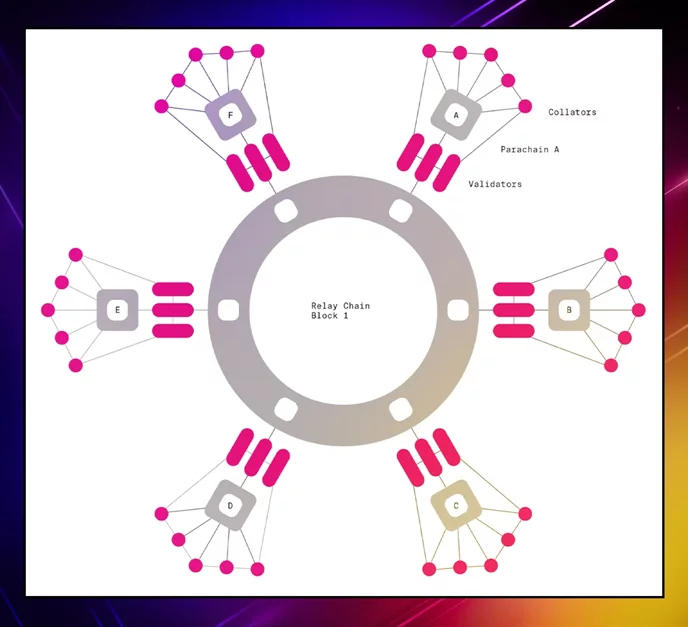
DOT is the native token of Polkadot Network, which connects smaller networks like Statemint, Acala, Bitgreen, Clover Finance, or Efinity. They’re called “parachains” and interact with each other using the relay chain, which acts as a translator and bridge. This central network is what we call layer-0.
Polkadot launched in May 2020. It originally allocated parachain slots through competitive auctions, where DOT holders locked tokens to vote for their preferred network. That model has since been replaced by Agile Coretime, which lets teams purchase block-production time on the relay chain directly without locking capital for a fixed lease term. The change makes it faster and cheaper to launch a new parachain.
The relay chain currently runs hundreds of validators under a nominated proof-of-stake model. Each parachain inherits this shared security automatically. If the relay chain were disrupted, parachains would continue processing their own blocks but could no longer send messages to each other via XCM until the relay chain recovered.
Avalanche (AVAX)
Avalanche is a triple blockchain that launched in September 2020. It also supports smaller networks, now officially called Avalanche L1s, without a hard-coded limit. The P-Chain is the Layer-0 component that coordinates validator sets and creates new L1s. The number of active Avalanche L1s has grown well past 50 since the network’s launch.
The X Chain is generally for creating/managing tokens, and C Chain is the most used one to access dApps.
Subnets are designed so that they can overlap/validate each other while maintaining their own rules and token economics. The result is a highly efficient and decentralized network.
Another reason for this is that unlike Polkadot, Avalanche is Ethereum-compatible. Still, there are similar risks. The primary subnet (Chain X, P, and C) needs enough validators to avoid disrupting all others.
Cosmos (ATOM)
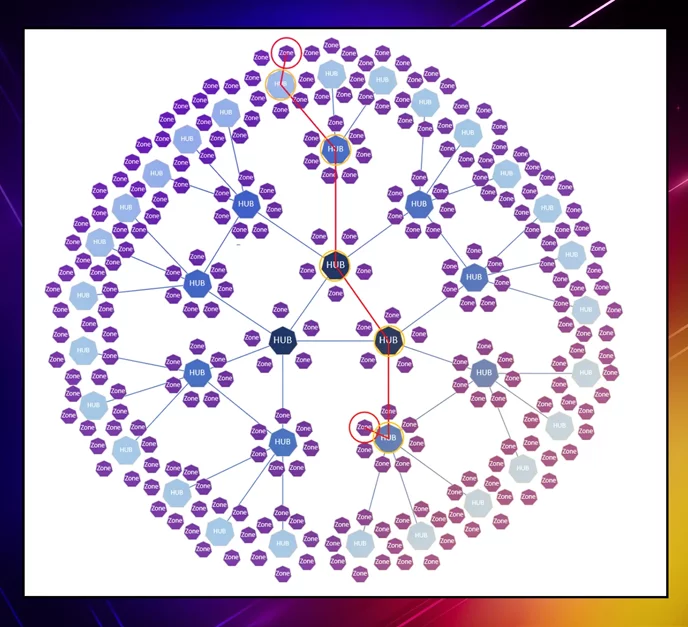
Unlike Avalanche and Polkadot, the Cosmos blockchain doesn’t have a central network. Technically there’s Cosmos Hub, but the other blockchains can transfer assets with each other without going through it. It launched in March 2019. The Cosmos ecosystem has grown significantly since then, with hundreds of IBC-enabled chains now active across the network.
The Cosmos Hub and SDK platform are the layer-0 component. They provide the other blockchains with simple governance tools and protocols to transfer directly (IBC, inter blockchain communication). The blockchains receiving the most connections (closest to the center in the picture) are called Hubs while the others are called Zones.
To avoid confusion, each icon represents an application-specific blockchain. For example, Cronos is the name of the token and platform, the only dApp within the Cronos blockchain.
However, the Cosmos network isn’t Ethereum compatible. Either you need a Cosmos wallet or an Ethereum port of the dApp. A third option is bridges and/or layer-0 protocols.
Types of Layer 0 Protocols
We defined a layer-0 blockchain as one that connects application-specific blockchains, typically built within it. Layer-0 protocols aren’t that way. They can be native to other blockchains (like Ethereum) and connect to other established ones.
E.g., The Chainlink protocol and token were created on Ethereum Mainnet but also works on Polkadot, Avalanche, Solana, BnB Chain, and others.
Hence why protocols are more common than layer-0 blockchains. It’s like comparing standalone networks to cross-chain platforms. The common types are:
Oracles
The first step to transferring tokens across blockchains is being able to transfer information. That’s essentially what oracles do, except they’re not limited to databases — they also share real-world data (e.g., weather). A few oracle examples are Chainlink, Tellor, and Fetch.
Decentralized oracles are an independent group of data reporters that provide and update prices and other information. All the data is public from the platform, and users have different incentives and penalties to ensure its integrity.
Without this layer-0 component, DeFi platforms wouldn’t have reliable metrics from other chains. If you track prices from Uniswap pools (e.g., ETH/USDT) and there’s a sharp drop in liquidity, the contracts may execute at the wrong prices.
Storage
Bitcoin is the best-known example of decentralized data storage. You can “delete” the blockchain, but it will always exist as long as someone else stores it. To keep it organized and updated, users need specific software to run a node and follow the consensus model.
The second part is the problem. While the tech behind it is decentralized, the one we interact with (front-end) is not:
- To use a dApp like Tornado Cash, you need its website/domain. If that’s the only means and they’re taken down, you can’t use it anymore.
- If you buy an NFT from the game Axie Infinity and it shuts down, the NFT will point to a not-found image link. The “proof-of-ownership” you paid for is gone.
The solution? Front-end decentralized storage. Examples of this are IPFS (Inter Planetary File System), Storj (STORJ), and Filecoin (FIL). IPFS, for example, allows you to upload files, assets, and websites to load them directly from the search bar.
The uploading is technical, but the access is as easy as visiting websites.
Now, if the blockchain shuts down, dApps and NFTs still exist on IPFS. They’re not stored on-chain only but also on this layer-0 protocol.
Cloud Web Services
Storage is just one of the many cloud services that blockchain can leverage.
As there are now storage coins, we may soon see more projects specialized for different types of web infrastructure:
- Virtual machine computing: Nodes share their processing power to help other users speed up certain actions and earn token rewards.
E.g. Bitcoin miners verify transactions for block rewards.
E.g. If you have a large zip file that takes hours to extract, you could use a powerful remote computer (virtual machine) to do it in no time for a fee.
- Domain name systems: Developers can buy domain NTFs (e.g. via Ethereum Name Service, ENS), upload the website to IPFS, and load websites even without a traditional host or domain registrar.
E.g. ipns://filecoin.io
- Content delivery networks (CDNs): CDNs store copies of web content in several locations worldwide, so anyone anywhere can use the closest source and load your platform much faster.
- Censorship-resistant RPC providers: This prevents governments and providers from prohibiting certain smart contracts.
E.g. Since the Tornado Cash blacklisting, the centralized RPC provider behind Metamask, Infura, censored the contract. If you switch from settings to a custom RPC like Ankr, you can still access it.
There’s already one big project that’s decentralizing the entire stack of Internet services: Internet Computer (ICP).
Token Bridges
Bridges allow us to send tokens and data across blockchains, and depending on the type, you could consider them as Layer 0 or 1.
Bridges are usually two nearly-identical dApps built on different blockchains. If the verification process is external or native, it’s considered a layer-0 protocol. If it’s local, it’s a layer-0 blockchain.
For context:
- Local = Validators from its own app-specific blockchain
- External = Off-chain “validator” methods such as oracles or multi-signatures.
- Native = Validators from respective blockchains (e.g. a BnB-Eth bridge has different validators in the BnB chain and Ethereum Mainnet)
In practice, bridges are far from layer-0. There’s no seamless connection between unrelated blockchains. There are complex problems with compatibility and security, and they get worse the more networks you add.
Some bridges never had issues. Others turned into the most expensive DeFi hacks of all time. Developers are still experimenting to find the perfect bridge architecture.
Why Layer-0 Is Becoming Institutional Infrastructure
For most of crypto’s history, Layer-0 was a developer concern. Builders cared about it; investors largely did not.
That is changing. ARK Invest and Citadel Securities backing LayerZero’s Zero blockchain is not a speculative bet on a new token. It is a signal that institutional capital sees Layer-0 as the settlement and compliance layer for regulated financial activity on-chain. Citadel Securities handles roughly 25% of all US equity trading volume. When they back cross-chain infrastructure, it is because they see a use case that goes beyond crypto-native applications.
The infrastructure argument still holds too. About 70% of Ethereum nodes run on centralized cloud providers like AWS. A Layer-0 disruption at the infrastructure level — an AWS outage, a government order to a hosting provider — could affect a significant portion of the network. Decentralized Layer-0 protocols like IPFS and Filecoin directly address this single point of failure.
The two threads are converging. Institutional users need compliant, high-security cross-chain rails. Retail users need censorship-resistant infrastructure. Layer-0 is the only layer positioned to serve both.
Frequently Asked Questions
Is Layer-0 the same as Layer-1?
No. Layer-1 is a standalone blockchain with its own consensus rules, like Bitcoin or Ethereum. Layer-0 sits beneath Layer-1 and provides the infrastructure that connects multiple Layer-1s. A Layer-1 can exist without a Layer-0, but it cannot communicate securely with other chains without one.
What is the difference between a Layer-0 blockchain and a Layer-0 protocol?
A Layer-0 blockchain (like Polkadot) creates and coordinates its own ecosystem of chains using a shared relay layer. A Layer-0 protocol (like Chainlink or LayerZero) is built on an existing blockchain and connects to external networks from the outside. Protocols are more common because they do not require building an entirely new chain ecosystem.
Which Layer-0 has the most institutional backing?
As of 2026, LayerZero Labs has the most prominent institutional backing for a Layer-0 infrastructure play. Its Zero blockchain raised funding from ARK Invest and Citadel Securities and is targeting institutional settlement use cases, with a launch planned for fall 2026.
Can a blockchain be secure without Layer-0 shared security?
Yes, but it has to earn that security itself. A new chain launching independently needs to attract enough validators or miners to make a 51% attack economically impractical. That takes time and capital. Shared security models, like Polkadot’s relay chain, give new chains the full security of the parent network from day one.
Max

Max is a European based crypto specialist, marketer, and all-around writer. He brings an original and practical approach for timeless blockchain knowledge such as: in-depth guides on crypto 101, blockchain analysis, dApp reviews, and DeFi risk management. Max also wrote for news outlets, saas entrepreneurs, crypto exchanges, fintech B2B agencies, Metaverse game studios, trading coaches, and Web3 leaders like Enjin.