
The United States has been a world-leading empire for much of the last century.
Every major empire Glubb studied eventually collapsed. The U.S. is not exempt from that pattern. But the stages are a map, not a sentence. Some empires took 50 years to move from Decadence to Collapse; others stretched it across 200. The speed depends on institutions, rivals, and choices made before the confidence crisis arrives.
The question remains: If an empire collapses, how do you avoid the fallout? And even more importantly, how could you benefit?
In this article, we will explore the seven stages before the collapse of an empire and the financial crisis that is associated with it, with a focus on the U.S.
The framework behind these seven stages was built by British military historian Sir John Bagot Glubb in his 1976 essay ‘The Fate of Empires and Search for Survival.’ Glubb studied fourteen major empires spanning roughly 3,000 years and found that most lasted around 250 years regardless of geography, religion, or military technology.
His seven stages — Pioneer, Commerce, Affluence, Intellect, Decadence, Decline, and Collapse — describe a pattern, not a prophecy. Recent academic work, including a 2026 Al-Adab Journal article applying Glubb and Ibn Khaldun to modern empires, treats the framework as a diagnostic lens rather than a fixed timetable. That distinction matters. The stages below map Glubb’s arc onto the U.S. monetary story, but no empire is locked into a predetermined exit.
Glubb’s Seven Stages at a Glance
Glubb’s original labels differ from the monetary framing this article uses. Here is how they align.
👉 Quick takeaway: Glubb’s cycle maps closely to monetary history. Empires begin with hard money and fiscal discipline, expand through trade, then debase their currency as decadence sets in. The final stages — decline and collapse — have historically required a full monetary reset before a new cycle can begin.
| Stage | Glubb’s Label | Monetary Parallel | Historical Example |
|---|---|---|---|
| 1 | 🟢 Pioneer | Hard money, conquest, discipline | Early Roman Republic; early British Empire |
| 2 | 🟢 Commerce | Trade expansion, currency standardisation | Venetian ducat era; British sterling dominance |
| 3 | 🟢 Affluence | Deficit spending begins, welfare programs expand | U.S. New Deal era, 1930s |
| 4 | ⚠️ Intellect | Debate replaces action; institutions bloat | U.S. post-1970s regulatory expansion |
| 5 | ⚠️ Decadence | Currency debasement accelerates; social cohesion erodes | U.S. post-1971 dollar float |
| 6 | 🔴 Decline | Loss of reserve currency confidence; rivals emerge | Ongoing dollar reserve share erosion |
| 7 | 🔴 Collapse | Currency reset; new hard-money standard emerges | Roman silver debasement to bronze; Weimar reset |
The table is a rough map, not a verdict. Glubb himself noted that stages overlap and that no empire progresses through them on a uniform timetable.
Hard Money
Empires typically begin on the right foot by establishing a hard-money system based on reserve assets like gold and silver.
Creating a currency that’s backed by hard money, such as the gold standard, is a step toward building an empire. The U.S. economy went on the gold standard in the 1870s, but it was short lived. The gold standard is one in which there is an equivalent amount of gold reserves stored in the Treasury to match the money supply.
So for every $20 banknote, there’s a $20 gold piece to back it in the vault.
Economies like the United States let a good thing slip away.
It wasn’t long before the U.S. began printing more banknotes than there was gold to back it up.
After more than a century with sound money, the country began inching away from that model.
In 1913, it was a 40% ratio reserve, devaluing the currency by over 50%. Things went from bad to worse. The U.S. went completely off the gold standard in 1971 under President Nixon.
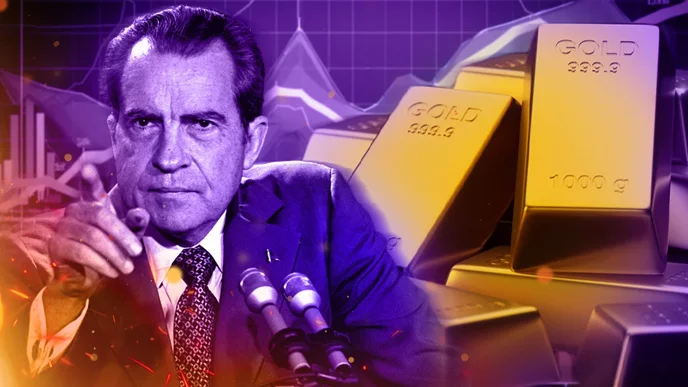
Glubb’s Pioneer stage maps directly onto this period. The discipline required to build on hard money is the same discipline that makes a civilization worth expanding in the first place. Once that discipline erodes, the later stages tend to follow in sequence — though the speed varies by empire.
Public Works Administration
The second nail in the coffin leading to the collapse of an empire could be explained during one of the worst economic times in U.S. history — the Great Depression.
This sad state of affairs prompted then President Roosevelt to create public works programs, funded by none other than currency inflation, aka deficit spending.
This involved several steps, including:
- Increasing the dollar-price of gold
- Putting the kibosh on the convertibility of banknotes for gold
- Prohibiting the private ownership of gold
The printing of gold certificates came to an abrupt halt.
Taxpayer dollars were being directed toward public programs, essentially turning the United States into a welfare state as the government sought to take control of the health and overall well being of its citizens.
Military Overextension and the Bretton Woods Crack
World War II turned the United States into the world’s armorer. While Europe and Asia bore the fighting, the U.S. sold tanks, guns, and materiel to Allied nations — and those nations paid in gold. American reserves swelled as a direct result, giving the U.S. a commanding monetary advantage over every other major economy by the war’s end.
That advantage was codified at Bretton Woods in 1944. World leaders agreed to crown the dollar as the global reserve currency, displacing gold as the direct anchor of international trade. Other currencies would now be backed by the dollar, and the dollar would be partially backed by gold. It looked like a stable arrangement. It contained a fatal flaw: the U.S. had made a promise it could only keep as long as its gold reserves stayed deep and its spending stayed disciplined.
Neither condition held. The Korean War, the Cold War, and Vietnam all followed in quick succession, each demanding enormous outlays. The cost of projecting military power overseas — whether through direct combat or through the machinery of deterrence — forced the U.S. into chronic deficit spending. Washington printed dollars to cover what taxes could not. The supply of dollars in the world grew. The gold backing those dollars did not.
By the late 1960s, the math had become impossible. Foreign governments and central banks, watching the dollar inflate, began redeeming their holdings for gold at the fixed rate the Bretton Woods agreement guaranteed. It was a slow-motion bank run on the United States. On August 15, 1971, President Nixon closed the gold window entirely, ending dollar convertibility and severing the last link between American currency and hard money. The promise made at Bretton Woods was broken, not by choice, but by the accumulated weight of decades of military overextension and the deficit spending it required.
Inflation and the Demise of Purchasing Power
At this point, President Nixon in the early 1970s is forced to backpedal on the country’s promise to supply gold for U.S. dollars.
As a result, the gold window was shut and other nations could no longer receive gold for their fiat money, paving the way for the gold price to float.
The dollar was detached from the precious metal and the store of value it represented.
It has been downhill ever since, with the dollar shaving off more than three-quarters of its purchasing power since then, removing yet another rung in this game of chutes and ladders.
Crisis of Confidence
With inflation soaring and the purchasing power of the dollar plummeting, the next step in the seven stages before the collapse of an empire is underway.
Consumers are losing confidence in the staying power of the dollar. U.S. national debt has surpassed $34 trillion and continues to climb, a figure that makes foreign dollar holders increasingly nervous. That discomfort is measurable: the dollar’s share of global central bank reserves has fallen from roughly 71% in 2000 to around 58% today, according to IMF COFER data — a slow bleed that accelerates the confidence problem.
Meanwhile, China is doing its best to displace the dollar as the go-to currency for oil trade.
However, what could be more likely on the horizon is a gold-backed oil trading.
As soon as people start losing faith in their currency, like the dollar, the dominos begin to fall.
For example, the U.S. becomes at risk of defaulting on its massive debt, which would result in a wave of deflation and yet another financial crisis soon on the heels of the last one.
Central bankers are already losing sleep over this potential scenario and it’s not even the worst-case scenario — the threat of hyperinflation is.
Store of Value Assets Endure
In this final phase of the seven stages before the collapse of an empire, fiat currency will fail.
Economies will have no choice but to reclaim a fixed standard so that the currency has some basis for its value.
The obvious choice is the gold standard, but it could also be something else, like a digital store of value like bitcoin.
Mike Maloney’s framing is blunt: this is ‘the greatest wealth transfer of all time.’ History backs the general direction. Gold held its purchasing power through the Roman debasement, the Weimar hyperinflation, and the 1971 dollar decoupling. Bitcoin is untested across a full currency collapse but has outperformed every major fiat currency since its 2009 launch by a margin that makes the comparison almost absurd.
The practical split most hard-money advocates suggest runs something like 60-70% physical gold and silver, 20-30% bitcoin, with the remainder in productive assets outside the banking system. That is not a regulated financial recommendation. It is the pattern that shows up consistently across collapse-preparation literature. The exact ratio depends on your timeline, your jurisdiction, and your risk tolerance.
The core point stands: fiat currency has never survived the full seven-stage cycle intact. Every reset has required a return to something with fixed supply.
What Stage Are We In Now? A Checklist
Glubb’s framework is not a countdown timer. But it does offer observable markers. Run through the list below and count how many apply to the current U.S. position.
Stage markers that are clearly present:
- Central bank monetizes government debt at scale (quantitative easing programs exceeded $8 trillion in cumulative Fed asset purchases by 2022)
- Currency has lost more than 96% of its 1913 purchasing power
- Military commitments exceed peacetime fiscal capacity
- Foreign rivals actively build alternative reserve systems (BRICS currency discussions, petrodollar alternatives)
Stage markers that are contested or partial:
- Reserve currency status is eroding but the dollar still represents roughly 58% of global reserves
- Political polarization is high but institutional collapse has not occurred
- Social cohesion is strained but not broken
A score of four or more ‘clearly present’ markers puts a modern empire in Glubb’s Decadence-to-Decline range. That is not a prediction. It is a pattern match.
How Ibn Khaldun’s Theory Fits In
Glubb was not the first to map civilizational cycles. The 14th-century Arab historian Ibn Khaldun described a similar arc through the concept of asabiyyah — roughly translated as social solidarity or group cohesion. Ibn Khaldun argued that empires rise on the strength of a unified, disciplined founding group and collapse when prosperity erodes that cohesion from within. Luxury softens the ruling class. Internal divisions replace collective purpose. Rivals with stronger asabiyyah eventually displace the weakened center.
The parallel to Glubb’s Decadence stage is direct. Both frameworks point to internal erosion rather than external conquest as the primary driver of collapse. A 2026 Al-Adab Journal study applying both theories to modern empires found that social fragmentation and fiscal overextension tend to arrive together in the later stages, reinforcing each other. That combination is harder to reverse than either factor alone.
For investors, the practical implication is the same whether you follow Glubb or Ibn Khaldun: when social cohesion and currency credibility both weaken simultaneously, the window to reposition narrows fast.
Can an Empire Reverse Course?
The honest answer is: rarely, and never quickly. Glubb found no clear examples of an empire halting its progression once the Decadence stage had taken hold. The Sociostudies almanac on civilizational cycles notes that institutional resilience, technological disruption, and deliberate policy reform can slow the process but have not historically reversed it in a fully mature empire.
That said, the framework is probabilistic, not mechanical. Three factors appear in the literature as potential brakes:
- Credible fiscal reform. Reducing debt-to-GDP before a confidence crisis forces the issue. This requires political will that late-stage empires rarely produce.
- Reserve currency defense. Maintaining the dollar’s reserve role through productivity growth and energy dominance, rather than through military threat alone.
- Social cohesion investment. Ibn Khaldun’s lens suggests that rebuilding asabiyyah — shared purpose, institutional trust — is as important as any monetary fix.
None of these are guaranteed. All of them take decades. The stages are a pattern, and patterns can be interrupted. But the interruption has to start before Stage 6.
Conclusion
Fiat currency has never survived a full empire cycle intact. Glubb’s fourteen historical cases all ended with some form of monetary reset. The U.S. has moved through at least five of his seven stages. That does not mean collapse is imminent or inevitable on any fixed schedule. It means the pattern is familiar and the protective moves are known.
Gold, silver, and bitcoin share one property that fiat currency does not: fixed or constrained supply that no central bank controls. That is the property that has mattered in every prior reset. Whether the current cycle ends in managed reform or disorderly collapse, owning some portion of your wealth outside the fiat system is the consistent historical lesson.
The seven stages are a framework for understanding where we are. What you do with that understanding is the only part of this equation you control.
Frequently Asked Questions
What are the seven stages of empire decline according to Glubb?
Glubb labeled them: Pioneer, Commerce, Affluence, Intellect, Decadence, Decline, and Collapse. Each stage reflects a shift in a civilization’s values, fiscal behavior, and social cohesion rather than a single political event.
Is the seven-stage collapse framework deterministic?
No. Glubb presented it as a recurring pattern across fourteen empires, not a fixed law. Scholars applying his work today treat it as a probabilistic diagnostic, not a countdown. Stage duration varies widely across historical cases.
How does Ibn Khaldun’s theory relate to Glubb’s stages?
Ibn Khaldun’s concept of asabiyyah — social solidarity — maps closely onto the transition from Glubb’s Affluence stage to Decadence. Both theorists identify internal cohesion loss, not external conquest, as the primary engine of collapse.
Which stage is the U.S. in now?
Based on the markers in this article — currency debasement, military overextension, declining reserve share, and rising political fragmentation — most analysts applying Glubb’s framework place the U.S. somewhere between Decadence and early Decline. That assessment is contested and depends on which indicators you weight.
Can an empire reverse the cycle?
Rarely. Glubb found no clear historical examples of a reversal once Decadence was entrenched. Credible fiscal reform, reserve currency defense, and social cohesion rebuilding are the three levers most cited in the literature, but all require political will that late-stage empires typically lack.
Gerelyn

Gerelyn is a financial journalist who has been covering Wall Street for more than 20 years. After reporting for some of the top trade publications on investment banking, infrastructure and retirement, she was drawn to decentralization and shifted her coverage to the blockchain and cryptocurrency space in mid-2017. Since then, she has contributed to several major Bitcoin, Blockchain, and DeFi news sites, and has also written a children’s book.