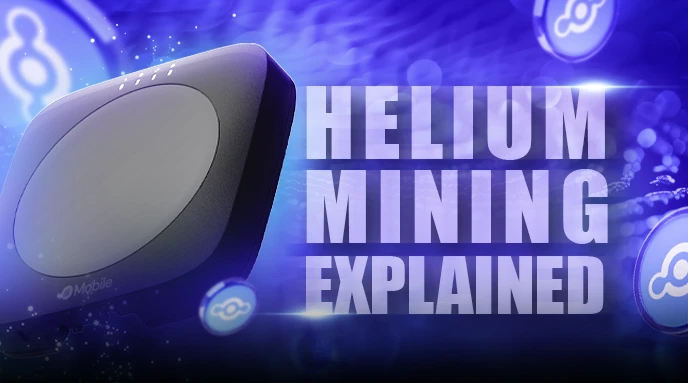
A Helium miner — also called a Helium hotspot — is a small, internet-connected device that builds and extends the Helium Network, a decentralized wireless infrastructure built for the Internet of Things (IoT).
Using LoRaWAN radio technology, these devices provide long-range wireless coverage for IoT devices like asset trackers, soil sensors, and smart meters, while earning their owners HNT cryptocurrency in return. Unlike traditional cryptocurrency mining, which demands power-hungry GPUs or ASICs, Helium miners consume just 5–15 watts — similar to a Wi-Fi router.
The Helium Network is powered by blockchain technology and relies on a unique consensus mechanism called Proof-of-Coverage (PoC). This system ensures that miners are genuinely contributing to network expansion while rewarding them for their efforts.
How Helium Mining Works
Helium miners are compact wireless devices that connect to the Helium Network using LoRaWAN radio technology — a long-range, low-power protocol purpose-built for IoT devices. Once deployed, they communicate with nearby hotspots and transmit data for IoT devices such as soil sensors, asset trackers, alarm sensors, and smart meters. The network is decentralized, meaning individual hotspot owners collectively build and maintain global wireless coverage.
The setup process is simple:
- Install the miner and connect it to Wi-Fi or Ethernet.
- The device verifies network coverage by interacting with nearby hotspots.
- When your miner successfully validates coverage and facilitates data transmission, you earn HNT tokens.
Your HNT earnings depend on several factors:
- Location: Miners in areas with low existing coverage earn more than those in oversaturated regions. Use the Helium Explorer map to check local density before purchasing.
- Network Density: Too many miners in close proximity dilute Proof-of-Coverage rewards. The optimal setup has nearby hotspots for witnessing, but not so many that rewards are split.
- Uptime: Consistent uptime (targeting 99%+) maximizes both PoC rewards and data transfer earnings.
- Data Transfer Activity: When nearby IoT devices route data through your hotspot, you earn additional HNT beyond PoC rewards.
- Hardware Compatibility: Only approved hotspot models earn rewards; verify your device is on Helium’s approved hardware list.
Because Helium mining relies on radio frequencies, strategic placement is critical. A poorly positioned miner may see significantly lower rewards than one placed in an optimal location with minimal interference and strong connectivity.
Helium Miner Hardware: What to Look For
Not all Helium hotspots are equal. Before purchasing, verify the device meets three criteria:
- It is on Helium’s approved hardware list
- It supports the correct frequency band for your region (e.g., 915 MHz for North America, 868 MHz for Europe)
- It is purchased from an official manufacturer or authorized distributor to avoid scams.
Key Specs to Compare (Helium Miners)
👉 Quick takeaway: The wrong frequency band or an unapproved device means zero rewards—always verify compatibility before buying.
| Feature | What to Check | Why It Matters |
|---|---|---|
| Frequency Band | Match to your country (915 / 868 / 923 MHz) | ⛔ Wrong band = no rewards |
| Antenna Gain (dBi) | Higher gain for flat terrain, lower for urban |
Affects coverage radius 🏆 Optimizes earnings potential |
| Approval Status | Listed on Helium’s approved hardware page | ⛔ Unapproved devices earn nothing |
| Price Range | Typically $300–$600 USD new | Calculate break-even vs. expected HNT earnings |
| Power Consumption | 5–15 watts typical |
Low operating cost 🏆 ~$5–15/year electricity |
Counterfeit and misrepresented Helium miners are common. Only buy from manufacturers listed on the official Helium documentation or well-known distributors. Avoid third-party marketplace listings that promise unusually high returns or pre-mined HNT balances.
How to Get Started with Helium Mining (Step-by-Step)
- Check local coverage density: Visit the Helium Explorer map and search your address. Look for areas with some nearby hotspots (for witnessing) but not oversaturation.
- Choose a compatible hotspot: Select a model approved for your region’s frequency band from Helium’s official hardware list. Budget $300–$600 for a new device.
- Set up the device: Connect to power and your home internet (Ethernet preferred for stability). Follow the manufacturer’s app for initial configuration.
- Register to your Helium wallet: Download the Helium app or a compatible wallet, create your account, and onboard the hotspot. There is a small onboarding fee (paid in Data Credits).
- Optimize placement: Position the miner as high as possible (rooftop or upper floor) with a clear line of sight. Avoid basements and metal enclosures.
- Monitor and maintain: Check PoC activity and data transfer earnings regularly. Keep firmware updated to stay eligible for rewards.
Estimated Time to First Reward
Most hotspots begin earning within 24–72 hours of coming online, once the network confirms coverage activity. Full reward optimization may take 1–2 weeks as the hotspot establishes its witness list.
Why Do People Use Helium Mining?
Helium mining offers several advantages over traditional cryptocurrency mining. One of the biggest benefits is energy efficiency. Unlike Bitcoin mining, which requires massive amounts of electricity, Helium miners consume very little power — comparable to a Wi-Fi router. This makes them cost-effective to operate.
Another advantage is passive income. Once a miner is set up, it requires minimal maintenance while continuously earning HNT. To put the economics in perspective: a typical hotspot consumes 5–15 watts of electricity, costing roughly $5–$15 per year to run (at average US electricity rates). Hardware costs typically range from $300–$600. Whether that investment pays off depends heavily on your location’s coverage density, the current HNT price, and network activity — which is why researching your local area before buying is essential.
The Risks of Helium Mining
The risks of Helium mining fall into four main categories:
- Network Saturation: If too many miners are placed in the same area, PoC rewards are diluted. Research local coverage using the Helium Explorer before purchasing.
- Regulatory Restrictions: Different countries have rules about unlicensed radio spectrum use. In some regions, operating a LoRaWAN device requires registration or is restricted entirely. Verify local regulations before importing or deploying hardware.
- Scams and Counterfeit Hardware: The Helium miner market has significant fraud risk. Fake devices, inflated earnings claims, and unauthorized resellers are common. Only purchase from manufacturers listed in official Helium documentation.
- Token Price and Reward Volatility: HNT earnings are paid in cryptocurrency, meaning their dollar value fluctuates with the market. Changes to Helium’s tokenomics or governance (such as the 2023 migration to Solana) can also affect reward structures.
The Future of Helium Mining
As IoT adoption accelerates, demand for decentralized wireless networks like Helium is expected to grow. The Helium network has expanded beyond its original LoRaWAN IoT use case. Helium Mobile (using the MOBILE token) operates as a separate subnetwork enabling decentralized 5G coverage through different hardware (CBRS small cells). These are distinct from LoRaWAN hotspots and require different equipment. For most new participants, the LoRaWAN IoT hotspot remains the most accessible entry point.
However, changes in tokenomics, governance, or competition from other decentralized wireless projects could impact Helium’s long-term success. Staying informed and adapting to network updates will be key for miners who want to maximize earnings and stay ahead of the curve.
Will Helium mining continue to be a profitable frontier in decentralized wireless technology? Only time will tell — but those who position themselves wisely could reap the benefits.
FAQ
Is Helium mining profitable?
Helium mining can be profitable, but it depends on location, network density, current HNT price, and hardware costs. Areas with low existing coverage and active nearby IoT devices generally offer better earning potential. Use the Helium Explorer map to research your area before investing.
How much electricity does a Helium miner use?
Most miners consume 5–15 watts — similar to a small LED bulb. At average US electricity rates, this costs roughly $5–$15 per year to operate.
Do I need an internet connection for a Helium miner?
Yes. A stable Ethernet connection is preferred over Wi-Fi for maximum uptime and reliability.
Can I run multiple Helium miners in the same location?
Running multiple miners in very close proximity reduces rewards due to network redundancy rules. Hotspots should generally be spaced at least 300 meters apart for optimal earnings.
How do I check if my area is good for Helium mining?
Visit explorer.helium.com and search your location. Look for areas with some existing hotspot activity (which enables witnessing) but not heavy saturation.
Are there scams I should watch out for?
Yes. Only purchase from manufacturers listed on official Helium documentation. Avoid third-party listings that promise guaranteed returns or pre-mined HNT balances.
What frequency band does my miner need?
Frequency bands vary by region: 915 MHz for North America, 868 MHz for Europe, 923 MHz for Asia-Pacific. Using the wrong band means your miner will not earn rewards.
Connor

Connor is a US-based digital marketer and writer. He has a diverse military and academic background, but developed a passion over the years for blockchain and DeFi because of their potential to provide censorship resistance and financial freedom. Connor is dedicated to educating and inspiring others in the space, and is an active member and investor in the Ethereum, Hex, and PulseChain communities.