
Despite accounting for billions of dollars in spending each year, in-game items and currencies have long been devoid of real-world value.
The GameFi movement is working to fix this major oversight.
But what value can be created when we merge video games with decentralized financial technology?
What is GameFi?
GameFi is short for game finance. It’s a way of thinking about the intersections of value that can exist when applying the benefits of decentralized technology to the world of gaming.
Since the early days of crypto adoption, the idea of finding a way to combine decentralized technology with video game experiences has remained popular.
Back in 2018, this came to a head when Fred Wilson’s VC firm, Union Square Ventures, gave millions in funding to CryptoKitties: one of the very first public-facing instances of GameFi.
At the time, Fred Wilson justified the investment in a blog post.
“Digital collectibles are one of many amazing things that blockchains enable that literally could not be done before this technology emerged,” he wrote. “We also think digital collectibles and all of the games they enable will be one of the, if not the first, big consumer use cases for blockchain technologies.”
In many ways, the intersection of gaming and decentralized finance is a no-brainer.
After all, video game currencies can be thought of as an early prototype—albeit a very limited one—of the digital currencies that we have today.
Take massively multiplayer online games (MMOs) as an example. Searching the name of an MMO followed by a phrase like “buy gold” presents you with a range of websites on which you can trade fiat currency for an in-game currency that players perceive to have value.
While this often occurs in violation of a game’s terms of service, this is nonetheless a massively profitable industry. Within it, people conduct virtual labor by playing games to earn and then sell a “virtual currency”. Some game publishers have even built their business practices around encouraging this.
According to The New Yorker, people spend more than $80 billion USD a year on virtual goods sold in video games. That figure predates the blockchain gaming era. The actual value at stake in GameFi-native economies is a fraction of that, but it is growing.
But unlike cryptocurrencies, the value of virtual currencies and goods is severely limited in a way that is unfair to everyone other than the game’s publisher.
To understand how GameFi addresses this issue, we need to understand what decentralized finance has to offer.
What is DeFi?
DeFi is the decentralized finance industry. It is a juggernaut that encompasses everything from cryptocurrencies to the use of blockchain technology to enable decentralized financial platforms.
The core value of DeFi lies in the fact that it is decentralized; there is no single person or entity in control. Rather, the platform is governed by the users themselves.
This is handled through transparent and auditable software that allow trustless exchange to occur between peers in a network. In a decentralized system, the aim is for power to be distributed fairly.
This serves in stark contrast to traditional finance, where intermediaries such as banks and financial platforms are in control.
In other words, where DeFi attempts to give power to the many, traditional finance only gives power to the top few.
Today, thanks to the popularity of cryptocurrencies, decentralized applications (dApps), and other DeFi platforms, decentralized finance is widely recognized. The landscape accounts for billions of dollars in value each year.
GameFi vs DeFi: Side-by-Side
These two sectors overlap but serve different primary goals. Here is how they compare across the dimensions that matter most.
👉 Quick takeaway: GameFi blends gaming with on-chain asset ownership and play-to-earn mechanics. DeFi replaces traditional financial intermediaries with smart contracts. Both run on blockchain, but they serve fundamentally different users with different risk profiles and different definitions of success.
| GameFi | DeFi | |
|---|---|---|
| Primary Goal | Earn real-world value through gameplay | Access financial services without intermediaries |
| Core User | Gamer seeking ownership and income | Investor or borrower seeking yield or credit |
| Main Assets | NFT items, in-game tokens, play-to-earn rewards | Cryptocurrencies, liquidity pool tokens, stablecoins |
| Ownership Model | 🟢 On-chain; player owns assets verifiably | 🟢 On-chain; user controls funds via wallet |
| Typical Risk | ⚠️ Token collapse, project shutdown, low gameplay depth | ⚠️ Smart contract exploits, liquidation, regulatory action |
| Revenue Model | Token emissions, NFT sales, in-game transactions | Trading fees, lending interest, yield farming |
| 2025-2026 Status |
⚠️ Reset phase 93% of early projects failed; survivors focus on gameplay quality |
🟢 Mature sector Expanding into PayFi, RWA, and on-chain money markets 🏆 More established ecosystem |
| Best Suited For |
Players who want ownership of what they earn 🏆 Best for gamers seeking on-chain asset ownership |
Users seeking financial services or passive yield 🏆 Best for financial services and yield generation |
The biggest practical difference: DeFi is primarily a financial tool. GameFi wraps financial incentives inside a game. That wrapper changes the risk profile entirely, because the sustainability of your returns depends on whether the game itself retains players.
How DeFi Creates Real Value for Gaming Through GameFi
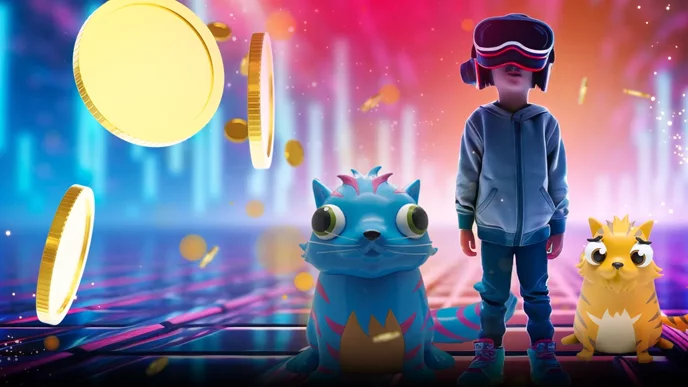
Long before the DeFi industry became the juggernaut that it is today, visionaries identified that one of its primary use cases could involve revolutionizing the gaming industry.
While players have collectively spent billions of dollars buying in-game goods and currencies each year, the fact is that these “currencies” have traditionally been disconnected from real-world value.
The main reason why in-game currencies like gold in World of Warcraft and InterStellar Kredit in EVE Online, for example, are not considered to be true virtual currencies is because they exist entirely within a game.
Worse still, players do not actually own their items or in-game currencies.
At any given point in time, the publisher of a game can instantly render all of your in-game holdings null—regardless of how much time you spent earning them or what they mean to you.
Game publishers could revoke your items, suspend your account, shut down their servers, make an item untradable, and/or inadvertently tank the value of in-game assets.
In fact, most games will actually ban you for trying to “cash out” should you ever choose to sell your in-game currency for real-world currency.
GameFi addresses this issue by introducing video games to the core benefit of DeFi: decentralization.
By leveraging blockchain technology in the same way that cryptocurrencies and NFTs do, games can allow their users to actually own their in-game items.
When tied to a distributed ledger, in-game items become immutable and can also be easily traded for real-world value. In some instances, a player can even take their items with them between different games and online worlds.
When considered in the context of players spending over $80 billion dollars a year on in-game items, GameFi means allowing that value to connect back into the real world.
As a result, GameFi has massive implications for both gaming and the broader DeFi landscape.
Where GameFi Stands in 2026
2025 was a hard year for GameFi. Token market capitalization across the sector fell to roughly $7.8 billion. About $544 million in funding reached 114 projects. Most critically, approximately 93% of early GameFi projects effectively ceased to exist, with token values down around 95% from their peaks.
That is not a footnote. It is the defining fact of the current GameFi landscape.
The projects that survived share a common trait: they prioritized gameplay depth and real player retention over token emissions. The sector is now described by analysts as entering a structural reset, with 2026 positioned as an inflection point rather than a continuation of the 2021-2023 hype cycle.
Projections for 2026 put the GameFi market between $20 billion and $30 billion, driven by AI integration, stablecoin adoption inside game economies, and cross-chain asset interoperability. Long-term forecasts to 2035 range from $156 billion to over $280 billion, at a projected compound annual growth rate of 27 to 32 percent.
DeFi, by contrast, has matured into a broader infrastructure layer. Binance Research’s 2026 themes highlight PayFi, on-chain money markets, and real-world asset integration as the next major expansions. These trends are beginning to intersect with GameFi directly. Yield-bearing stablecoins are being embedded into game economies. Tokenized real-world assets are being used as collateral within gaming platforms.
The symbiotic relationship between DeFi and GameFi is real. But it now runs through sustainability rather than speculation.
GameFi 2.0: What Changed After the Reset
The original play-to-earn model had a structural flaw. It rewarded early participants with token emissions. New players funded those rewards by buying in. When new player growth slowed, token prices collapsed and the economy unwound. Axie Infinity’s SLP token losing over 99% of its value is the clearest example.
GameFi 2.0 is the industry’s answer to that failure.
Three shifts define it. First, gameplay comes before economics. Projects in 2026 are built to be genuinely fun, with skill-based progression that gives players reasons to stay independent of token price. Second, earnings are tied to skill and time invested rather than to how early you arrived. This makes the economy more durable. Third, AI is being used inside game economies for personalization, fraud detection, and dynamic difficulty adjustment, all of which improve retention.
The terminology shifted too. ‘Play-to-Earn’ has largely given way to ‘Play-and-Earn,’ a framing that signals the game experience is primary and the financial layer is secondary. That ordering matters for sustainability.
Cross-chain asset ownership is another feature of the 2.0 model. A sword earned in one game can, in principle, be carried into another. Stablecoins are replacing volatile native tokens as the reward currency in some ecosystems, removing the inflation spiral that killed earlier projects.
Not every project claiming the 2.0 label has earned it. But the indicators of genuine quality are now clearer: active daily wallets, rising average revenue per paying user (ARPPU), low token inflation, and a gameplay loop that works without financial incentives.
How to Spot a Durable GameFi Project: A Practical Checklist
Most GameFi projects will not survive. That is not pessimism; it is the documented rate. Use this checklist before committing time or capital to any GameFi project.
Gameplay first test
Would you play this game if there were no token rewards? If the honest answer is no, the economy is likely a ponzi structure waiting for player growth to slow.
Token inflation check
What is the token emission schedule? Projects with uncapped or rapidly expanding token supplies almost always see price collapse as early players exit. Look for deflationary mechanisms or stablecoin-denominated rewards.
Team and audit transparency
Is the team public and verifiable? Has the smart contract been audited by a named third party? Anonymous teams with unaudited contracts are the highest-risk combination in the sector.
Engagement metrics over price
Daily active wallets and ARPPU (average revenue per paying user) are more meaningful than token price. A project with 50,000 daily active wallets and rising ARPPU is healthier than one with a high token price and declining users.
Cross-chain and interoperability signals
Can assets be moved across chains or into other games? Projects with locked, single-chain assets are more vulnerable to platform-level failure.
Regulatory posture
Does the project have a clear legal structure? In 2026, regulatory scrutiny of GameFi has increased across the US, EU, and APAC. Projects with no compliance framework face existential risk from enforcement actions.
No single factor is decisive. A project can pass five of six checks and still fail. But a project that fails three or more checks has a very high probability of joining the 93% that did not survive.
Regulatory Risk: The Factor Most Articles Skip
GameFi sits in an uncomfortable regulatory position. It combines elements of gaming (generally lightly regulated), financial products (heavily regulated), and securities (regulated with significant penalties for non-compliance).
In the US, the core question is whether a GameFi token constitutes a security under the Howey Test. Tokens sold with an expectation of profit derived from others’ efforts meet that definition in most analyses. Several projects have already faced SEC scrutiny.
The EU’s MiCA framework, which came into full effect in 2024, creates clearer rules for crypto assets but does not resolve all GameFi-specific questions, particularly around NFTs and in-game token rewards.
APAC jurisdictions vary widely. Singapore has positioned itself as crypto-friendly with clear licensing pathways. Japan and South Korea have stricter rules around token issuance and trading.
For players, the practical risk is simpler: if a project shuts down following regulatory action, your assets may become worthless regardless of their on-chain status. Choosing projects with visible legal structures and compliance frameworks is not a guarantee, but it is a meaningful risk filter.
DeFi faces many of the same regulatory questions. The difference is that DeFi protocols are often more decentralized in structure, which can complicate enforcement. GameFi projects, which typically have identifiable development teams and centralized game servers, are easier targets for regulators.
Frequently Asked Questions
Is GameFi still worth participating in after the 2025 crash?
It depends entirely on the project. The 93% failure rate means most projects are not worth your time. The survivors share specific traits: genuine gameplay, low token inflation, audited contracts, and visible teams. Apply the checklist above before committing.
What is the main difference between GameFi and DeFi?
DeFi is a financial infrastructure layer. GameFi wraps financial incentives inside a game. DeFi protocols generate yield through lending, trading fees, and liquidity provision. GameFi generates income through gameplay activity, NFT ownership, and in-game token rewards.
Can you use DeFi tools inside a GameFi project?
Yes, and this is increasingly common. Some GameFi projects allow players to stake in-game tokens in DeFi liquidity pools, use yield-bearing stablecoins as in-game currency, or borrow against NFT assets. The boundary between GameFi and DeFi is becoming less distinct in 2026.
What is GameFi 2.0?
GameFi 2.0 refers to projects that prioritize gameplay quality and player retention over token emissions. The term signals a departure from the pure play-to-earn model. Key features include skill-based progression, stablecoin rewards, AI-driven personalization, and cross-chain asset portability.
What are the biggest risks in GameFi?
Token collapse is the most common risk. Regulatory action is the fastest-growing risk. Smart contract exploits, project abandonment by anonymous teams, and platform-level shutdowns are also significant. No GameFi investment is insured or recoverable through traditional financial protections.
Connor

Connor is a US-based digital marketer and writer. He has a diverse military and academic background, but developed a passion over the years for blockchain and DeFi because of their potential to provide censorship resistance and financial freedom. Connor is dedicated to educating and inspiring others in the space, and is an active member and investor in the Ethereum, Hex, and PulseChain communities.