
The biggest barrier to everyday crypto use has always been convenience. But that is changing fast: crypto debit card spending hit $607 million in a single month in March 2026, up 211% year-over-year, as Visa and Mastercard both expand their crypto rails.
In this article, we are going to review crypto debit cards and study some of their pros and cons.
Most importantly, we are going to review their key drawback, i.e. centralization, and offer some ways to resolve this problem.
What is a Crypto Debit Card?
A crypto debit card is a type of payment card that allows users to spend their cryptocurrencies, such as Bitcoin, Ethereum, or other digital assets, for everyday transactions. It bridges the gap between traditional fiat currencies (like the US dollar or Euro) and cryptocurrencies, enabling individuals to use their crypto holdings in the same way they would use a regular debit card linked to a bank account.
In a nutshell, a crypto debit card works pretty similarly to a traditional bank card. What makes it different is the possibility to store crypto along with traditional fiat currencies. Such cards enable their owners to spend cryptocurrencies with ease while making daily purchases.
Cryptocurrency adopters praise digital assets for fast borderless transactions, low fees, and universal acceptance. Yet, even with all the wallets and exchanges that are now available in the market, they are still hardly suitable for daily shopping.
One has to perform many extra actions to start using crypto, from getting a verified account on an exchange to finding a shop that officially accepts digital coins.
Crypto cards remove this gap. Linked to a crypto wallet, such a card automatically converts crypto into fiat and sends funds to the merchant’s bank account. What’s more, some cards even enable cash withdrawals in ATMs.
Top Crypto Debit Cards Compared
👉 Quick takeaway: The best crypto card depends on whether you prioritize DeFi integration, stablecoin spending, or broad merchant acceptance. Fee structures vary significantly — always check the total end-to-end cost, not just the headline rate.
| Card / Provider | Network | Supported Assets | Key Fee | Cashback | Best For | Region |
|---|---|---|---|---|---|---|
| Wirex Chimera Card | Mastercard |
Bitcoin, multi-asset 🏆 On-chain spending |
⚠️ 0.5–3% FX markup (verify with issuer) | Yes (varies by tier) |
80M+ merchant acceptance 🏆 Best for global reach |
Global |
| MetaMask Card | Mastercard |
ETH, stablecoins 🏆 DeFi-integrated |
⚠️ 0.5–3% FX markup (verify with issuer) | Not confirmed |
DeFi wallet users spending on-chain assets 🏆 Best for DeFi users |
⚠️ Expanding regions |
| MoonPay Stablecoin Card | Mastercard |
USDC, USDT 🏆 AI-agent compatible |
⚠️ 0.5–3% FX markup (verify with issuer) | Not confirmed |
Stablecoin holders, physical and online spending 🏆 Best for stablecoin spending |
Global |
The History Of Crypto Debit Cards
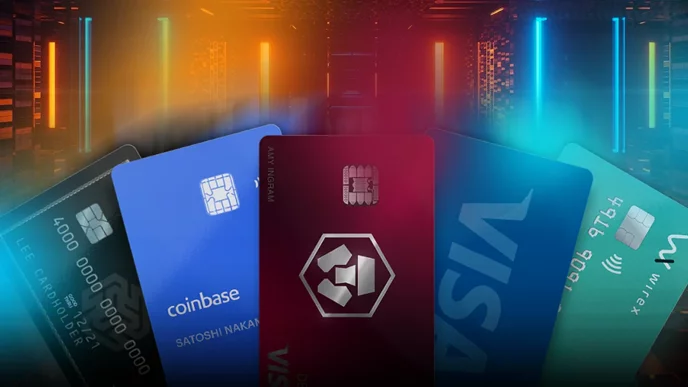
Here’s a brief overview of some key milestones that crypto cards have passed through over time.
2013: Xapo and E-Coin became the first companies to launch crypto debit cards supported by VISA and MasterCard. This early move was doomed to fail, though, mostly due to regulatory issues. High transaction fees and limited acceptance weren’t helpful at this stage either.
2015: Shift Payments partnered with Coinbase to issue Bitcoin debit cards. Users could link these cards to their wallets on this exchange and seamlessly spend bitcoins in local shops.
2016-2017: As Bitcoin was gaining popularity, more providers were joining the race. TenX, Centra, MonaCo, Crypterium, and many other companies launched their versions of Bitcoin cards in that period of time.
2018: Since the crypto market was still lacking proper regulations, some fraudulent players managed to increase their profits while avoiding proper customer verification procedures.
Thus, WaveCrest, one of the key crypto card issuers at that time was banned by VISA for numerous violations of the KYC (know-your-customer) procedure.
2021: Despite the long-lasting crypto winter that began in 2018, VISA didn’t turn away from crypto. It was obvious that the adoption of new technologies was only going to grow. In 2021, the global card issuer partnered with 50 leading crypto platforms boosting the total sum of money spent up to a $1 billion threshold.
2022-2023: The number of crypto card providers grew significantly, but the market remained fragmented with inconsistent regulatory treatment across regions.
2025-2026: The market entered a new phase of maturity. Mastercard partnered with MetaMask in February 2026 to launch a crypto debit card with stablecoin and DeFi integrations. MoonPay launched a stablecoin debit card on the Mastercard network in May 2026. Wirex introduced the Chimera Card, bringing Bitcoin spending to 80 million merchants. Monthly crypto card spending reached approximately $607 million by March 2026, a 211% year-over-year increase. MiCA regulation in the EU has simultaneously raised compliance requirements, leading to some card programs exiting certain markets while driving higher standards industry-wide.
How To Select A Crypto Debit Card?
At the time of writing, there are a few dozen of options one may select from. With such a large variety, how to pick up the best crypto debit card for daily usage?
Here are the key aspects to consider:
- Geographical coverage: check if the given card provider operates in your region. It’s the first and the most important aspect to find out.
- Issuing company: study the card provider’s reputation by reading reviews on third-party platforms. Pay specific attention to how it is regulated and if it has ever faced any fines.
- Security: in addition, check what options the card offers for protecting your crypto, if it has 2FA, and if it encrypts your funds. Also, find out if there have been any incidents with customers’ personal data leakage.
- Supported coins: check if the card supports any other coins apart from the most popular options like Bitcoin or Ethereum. Even if you don’t consider investing in anything else now, you may change your mind later.
- Fees: look beyond the headline: early crypto card programs often advertised zero or minimal fees, but current models typically include an FX conversion markup (commonly 0.5-3% per transaction), potential monthly or annual card fees, ATM withdrawal fees, and cross-border transaction charges. A card advertising 0% FX may embed a spread into the conversion rate. Always calculate the total end-to-end cost for your typical monthly spend volume. Aggregators like CryptoCardIndex compare 30+ cards on total fee structures.
- Acceptance: think ahead of how and where you are going to use this card. Find out if your favorite merchants accept such a payment option at all.
- Conversion rates: look out for the cards with the best exchange rate for switching crypto into fiat and vice versa. Don’t forget about the fees, though, as cards with better rates may charge higher commissions.
- Wallet compatibility: check if the card is compatible with the crypto wallet of your choice. Equally important, check if the process of linking these two is secure and simple enough.
- Customer support: study end-users’ reviews on third-party platforms such as TrustPilot or NerdWallet. It’s also useful to check frequently asked questions to see if this section provides sufficient information on the most acute topics.
- Rewards: last but not least, see what cashback rewards the card offers. Such reward programs may be really useful, especially for large purchases
A Decision Framework
- Check your region first: confirm the card is licensed and available where you live. MiCA and PSD2 compliance now determine availability across the EU; US users face different licensing requirements.
- Decide your primary spend asset: if you want to avoid volatility at point of sale, choose a card that supports USDC or USDT as the primary spend rail. If you prefer spending native crypto (BTC, ETH), confirm the card supports real-time conversion.
- Calculate your true cost: take the FX markup (typically 0.5-3%), add any monthly/annual card fee, and subtract cashback. Example: on $500/month spend at 1.5% FX markup with no cashback = $7.50/month in fees. A card with 1% cashback and 2% FX markup on the same spend = net $5/month cost.
- Assess custody model: custodial cards hold your crypto on your behalf (counterparty risk). On-chain cards like Wirex allow spending directly from a self-custodied wallet.
- Verify KYC requirements: all regulated cards require identity verification. Cards that previously offered minimal KYC have tightened procedures post-MiCA.
Crypto Card Regulations: What You Need to Know
Regulatory changes since 2024 have significantly reshaped which crypto debit cards are available and where. Key developments:
- MiCA (Markets in Crypto-Assets Regulation): now in force across the EU, MiCA requires crypto card issuers to hold an e-money institution or payment institution license. Several card programs have exited or restricted EU availability as a result.
- PSD2 compliance: EU-based card programs must also meet PSD2 strong customer authentication requirements.
- US 1099-DA reporting: as of 2025, US crypto card users may receive 1099-DA forms from issuers reporting digital asset disposals (each card swipe that converts crypto to fiat is a taxable event in the US).
- Post-MiCA KYC tightening: cards that previously offered light KYC have upgraded identity verification requirements. Always check a card’s current licensing status before applying.
In the US, every crypto-to-fiat conversion at point of sale is a taxable disposal. Keep records of each transaction for capital gains reporting.
Crypto Debit Cards: Pros and Cons
Crypto debit cards offer a number of benefits to those who use them, but still, they are not ideal. Consider the following positive and negative aspects if you plan to rely on this payment solution.
Advantages
- Ease of use: such cards allow spending your crypto in a way similar to traditional VISA debit cards which makes them just as convenient. Thus, they represent a tool that finally makes crypto suitable for daily purchases.
- Effortlessly exchange crypto for cash: verified users can easily convert crypto into fiat and vice versa. Besides, crypto cards make it possible to withdraw cash from ATMs which contributes to funds’ accessibility.
- Cashback and other perks: some crypto rewards programs offer their users much higher returns than the traditional banking sector. At the same time, spending limits of such cards are higher.
- No credit check: to get a crypto debit card, one does not have to pass any credit check. Thus, people with poor or zero credit history can still enjoy using convenient financial products.
- No bank account: users don’t have to link their crypto cards to bank accounts which may be a good option for remote and unbanked regions.
- Reduced costs: with crypto cards, users can exchange value in a much more cost-efficient way, especially in comparison with traditional wire transfers.
- Flexibility: Bitcoin is often not the only option to store crypto on a card. Many providers add a variety of other coins giving the flexibility to use other assets as well.
Disadvantages
- Geographical limitations: regional availability is now shaped significantly by licensing requirements. MiCA regulation across the EU and PSD2 compliance requirements have led several card programs to restrict or exit certain markets since 2024. Always verify a card’s current availability in your country before applying.
- Regulatory risks: MiCA, PSD2 in the EU, and evolving US digital asset regulation mean that card availability can change with limited notice. Post-MiCA, cards that previously operated with lighter compliance requirements have either upgraded KYC procedures or exited the market. In the US, each crypto-to-fiat conversion at point of sale is a taxable disposal event, and issuers may now issue 1099-DA forms.
- Deposit and withdrawal limits. Some cards impose limits on withdrawing and depositing funds just like regular bank cards.
- Taxes for US citizens: in this region, cryptocurrencies are subject to taxation, just like any other means of making a profit.
- Data privacy risks: not all crypto card providers may have enough reserves to ensure the security of their customers’ personal data. Pay specific attention to whether or not a given provider is subject to external audits and if it has passed them successfully.
- Limited support: not all card providers offer 24/7 support to their customers which may become really inconvenient in case any problems emerge.
- Dependence on the card issuer: your card may simply stop working if the issuing company blocks your region or loses its license as happened with Wavecrest in 2018.
As you may see, most of these disadvantages are inherent to traditional bank cards, too. Crypto cards may have limited functionality, impose high fees on different operations, and have limited acceptance across different merchants.
However, not every crypto card provider combines them all. Hence, detailed research can help you reduce most of these risks to a minimum.
Centralization As The Key Problem Of Crypto Debit Cards
Crypto debit cards have many different drawbacks. But still, most of them are nothing but a small inconvenience.
Yet, there is one more important negative aspect that may have serious consequences and disparage all the potential benefits. It’s centralization.
The majority of crypto debit card providers existing up to date offer their users custodial means for storing funds. Users don’t control their private keys. Thus, they don’t control their own funds either and they may lose them at any moment due to a central party failure.
Thus, such cards eliminate the key benefit of cryptocurrencies. In fact, they represent the same bank accounts with the possibility to store crypto as the only difference. Is there a way to resolve this issue and maintain all the conveniences at the same time?
Stablecoins and On-Chain Spending: How Crypto Cards Are Changing
One of the most significant shifts in crypto card design is the move toward stablecoins as the primary spend rail. Rather than converting volatile assets like Bitcoin at point of sale (and triggering potential tax events on gains), newer card programs allow users to pre-load or spend USDC or USDT directly. This reduces price risk and simplifies the conversion process.
Notable developments:
- In May 2026, MoonPay launched a stablecoin debit card on the Mastercard network, enabling both human users and AI agents to spend crypto at physical and online stores.
- In February 2026, Mastercard partnered with MetaMask to launch a crypto debit card with expanded stablecoin and DeFi integrations.
- On-chain spending is also maturing: Wirex reported $105 million in on-chain card volume for March 2026 alone, with 2.4 million cumulative on-chain transactions since its November 2025 production launch and 300 partners building on its API. This directly addresses the centralization concern raised earlier in this article — on-chain card infrastructure now exists and is processing real transaction volume.
A Plethora Of Decentralized Solutions
Blockchain has significantly evolved in recent years. The available technologies now make it possible to move away from physical cards to decentralized means of payment without giving up convenience.
Here are just a few examples of DeFi solutions that can help mitigate the centralization problem inherent to crypto cards:
- Decentralized exchanges (DEXes) enable their users to switch crypto directly between one another. They eliminate the risk of a centralized party failing and thus significantly increase funds’ security.
- Decentralized lending platforms such as Liquid Loans make it possible to lend and borrow crypto on a peer-to-peer basis in a similar way.
- Decentralized stablecoins, like USDL, are fully-backed by and redeemable for the native token of a decentralized blockchain. They are issued/created by an immutable and admin key free smart contract.
- Decentralized wallets provide their users with full control over their own seed phrases and in turn their own digital assets.
On-chain crypto card infrastructure is no longer a future concept — it is live and processing significant volume. Wirex’s on-chain card program recorded $105 million in card volume in March 2026 alone and has processed over 2.4 million on-chain transactions since launching in November 2025. Mastercard’s integration with MetaMask (February 2026) further demonstrates that major payment networks are actively building the rails for self-custodied spending.
The centralization problem that defined early crypto cards is being actively addressed — though custodial models remain dominant for now, users increasingly have on-chain alternatives. Decentralized stablecoins like USDL (issued by the Liquid Loans protocol) represent one component of a broader self-custodied payment stack, but connecting them to mainstream merchant rails remains an open infrastructure challenge.
Frequently Asked Questions About Crypto Debit Cards
How much do people spend on crypto debit cards monthly?
Crypto card spending reached approximately $607 million per month in March 2026, up 211% year-over-year from $187 million, driven primarily by USDC and USDT transactions.
Are crypto debit cards available in the EU after MiCA?
Availability varies by issuer. MiCA requires card issuers to hold appropriate EU payment institution licenses. Some programs have restricted EU access; check the specific card issuer’s current supported regions before applying.
Is spending crypto on a debit card taxable in the US?
Yes. In the US, each crypto-to-fiat conversion at point of sale is treated as a taxable disposal. Issuers may issue 1099-DA forms. Keep records of each transaction.
What is the difference between a custodial and on-chain crypto card?
Custodial cards hold your crypto with the issuer (you do not control private keys). On-chain cards like the Wirex Chimera Card allow spending directly from a self-custodied wallet, reducing counterparty risk.
Which new crypto cards launched in 2026?
Notable 2026 launches include the Mastercard-MetaMask crypto debit card (February 2026), the MoonPay stablecoin card on Mastercard (May 2026), and the Wirex Chimera Card bringing Bitcoin spending to 80 million merchants.
Kate

Kate is a blockchain specialist, enthusiast, and adopter, who loves writing about complex technologies and explaining them in simple words. Kate features regularly for Liquid Loans, plus Cointelegraph, Nomics, Cryptopay, ByBit and more.