
Derivative trading has been around long before cryptocurrencies came into existence.
In a nutshell, derivatives are contracts where a buyer and a seller make opposite bets on the future asset prices. The party whose bet eventually wins gets to take the profit.
In traditional finance, the underlying assets can be currencies, stocks, bonds, commodities, and any other type of tradeable items. When applied to cryptocurrencies, the approach is exactly the same. Buyers and sellers enter a financial contract on crypto exchanges speculating on the price of a given digital asset at a specific moment in the future.
Thanks to the highly volatile nature of the crypto industry, the potential gains can be really huge. At this, cryptocurrency derivatives enable traders to make higher profits.
Types of Crypto Derivatives
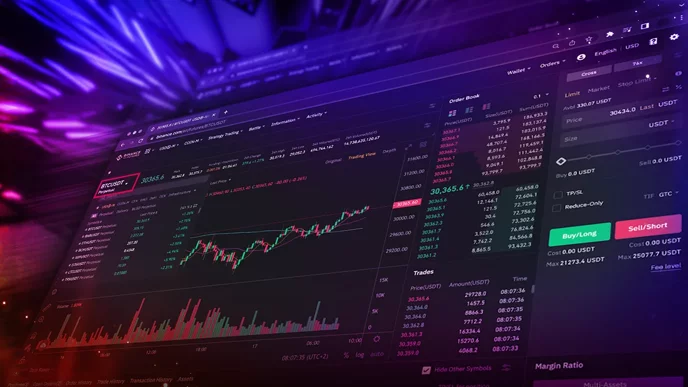
Crypto derivatives fall into the following categories depending on the derivative contract conditions.
Crypto Futures
Futures represent an agreement between a buyer and a seller to exchange a specific crypto asset in the future at a determined price regardless of the real market conditions.
How a Bitcoin futures trade works:
Assume Bitcoin is currently trading at $60,000. A trader believes the price will rise over the next month and enters a long futures contract for 1 BTC at $60,000 with a 1-month expiry.
Scenario A (trade wins): BTC price rises to $70,000 at expiry. The trader buys at the contracted $60,000 price and can sell immediately at $70,000, locking in a $10,000 gross profit.
Scenario B (trade loses): BTC price falls to $50,000 at expiry. The trader is still obligated to buy at $60,000 — a $10,000 loss on a $60,000 position.
With 10x leverage: If the trader only posted $6,000 as margin (10x leverage), the $10,000 loss in Scenario B exceeds the margin posted, triggering liquidation before expiry. This illustrates why leverage amplifies both gains and losses — and why risk management is critical in futures trading.
Crypto Options
These contracts are very much similar to the futures with the only key difference. A buyer of an option doesn’t necessarily have to purchase an asset when the specific date comes.
There are two key types of options:
- Call options enable traders to buy assets on a specific date.
- Put options enable them to sell them.
Thanks to options, traders can realize their purchases with leverage. For example, a trader may buy only a fraction of Bitcoin and gain a whole BTC if his bet wins.
On the contrary, if his bet loses he will only have to pay as much as he initially put on the bet.
Perpetual Contracts
Perpetual contracts (also called perpetual swaps or perps) are similar to futures but with no expiry date. Traders can hold them indefinitely as long as they maintain sufficient margin and pay the funding rate — a periodic fee exchanged between long and short position holders to keep the contract price anchored to the spot market.
How funding rates work in practice: If the perpetual contract trades above the spot price, longs pay shorts. If it trades below, shorts pay longs. Funding rates typically reset every 8 hours on major exchanges.
Worked example: A trader opens a $10,000 long BTC perpetual position at 10x leverage. If the funding rate is 0.01% per 8-hour period, the daily funding cost is approximately $3 (0.03% of $10,000). Over 30 days with stable rates, that is roughly $90 in funding fees — a real cost that compounds against your position if the price does not move in your favor.
Important regulatory note (2026): ESMA confirmed in February 2026 that perpetual-style crypto contracts fall within the scope of CFD product-intervention measures in the EU. This means EU retail traders face the same leverage caps and negative balance protections that apply to traditional CFDs when trading perpetuals on EU-regulated platforms.
Crypto Forwards
Forwards are similar to futures but are traded over-the-counter (OTC) rather than on an exchange. Two parties negotiate custom terms including the asset, quantity, price, and settlement date directly, without a standardized contract or central clearing. Forwards are primarily used by institutional traders and miners for bespoke hedging arrangements. Because they are OTC instruments, they carry counterparty risk — if the other party defaults, there is no exchange guarantee to fall back on.
Crypto Swaps
Swaps are agreements to exchange cash flows or exposures over a defined period. In crypto markets, swaps are most commonly used by institutional participants to manage interest rate exposure, funding costs, or to gain synthetic exposure to crypto price movements without holding the underlying asset. Like forwards, crypto swaps are typically OTC instruments subject to negotiated terms and counterparty risk. In the US, crypto swaps fall under CFTC jurisdiction.
Crypto Derivatives Compared: Futures, Options, Perpetuals, Forwards, and Swaps
👉 Quick takeaway: Options cap your maximum loss at the premium paid, making them the most risk-defined derivative. Perpetual contracts carry the highest leverage and no expiry, but are now treated as CFDs under EU product-intervention rules as of February 2026.
| Derivative Type | Expiry Date | Max Loss | Leverage Available | Best For | Regulatory Note (2026) |
|---|---|---|---|---|---|
| Futures | Fixed date | 🔴 Full position value | Yes (varies by platform) |
Hedging, directional bets 🏆 Most established derivative |
CFTC-regulated in US; MiFID II in EU |
| Options | Fixed date |
🟢 Premium paid only 🏆 Most defined risk profile |
Yes (via premium leverage) | Limiting downside while keeping upside | Regulated under securities / derivatives frameworks |
| Perpetual Contracts |
None (indefinite) ⚠️ Funding rate applies |
🔴 Full position + funding costs |
Up to 100x on some venues 🔴 Highest leverage risk |
Short-term speculation, continuous exposure | 🔴 ESMA: treated as CFDs under EU product-intervention rules (Feb 2026) |
| Forwards | Fixed date | 🔴 Full position value | Negotiated OTC |
Institutional hedging, custom terms 🏆 Most flexible structure |
OTC; counterparty risk applies ⚠️ No central clearing |
| Swaps | Varies | Varies by structure | Negotiated |
Institutional rate / exposure management 🏆 Best for institutional rate management |
CFTC jurisdiction in US |
How to Choose the Right Crypto Derivative
Use these questions to identify which derivative type fits your situation:
1. Do you want the option to walk away if the trade goes against you?
- Yes: Consider options (your max loss is limited to the premium you paid)
- No: Futures or perpetuals may suit your strategy
2. Do you need a fixed exit date for planning or hedging purposes?
- Yes: Futures or options with a specific expiry date
- No: Perpetual contracts let you hold indefinitely
3. Are you trading in the EU?
- Yes: Check whether your platform applies CFD leverage caps to perpetuals under ESMA’s 2026 product-intervention guidance
- No: Verify the regulatory framework in your jurisdiction before trading
4. Are you an institutional or professional trader?
- Yes: Forwards and swaps offer customizable OTC terms; regulated venues like Perpetuals.com (MiFID II MTF) are now available in Europe
- No: Exchange-traded futures and options on regulated venues provide better retail protections
5. How much capital are you risking?
- Under $1,000: Options premium-based strategies limit your maximum loss to the premium paid
- Over $10,000: Futures and perpetuals with defined margin management may be more capital-efficient for hedging
Advantages of Crypto Derivatives
Crypto derivatives play an important role in the crypto economy. At this, they provide traders and investors with a set of benefits.
Risk management
The cryptocurrency market is well-known for its high volatility. The price of digital assets may spike or drop dramatically without any warning signs.
Derivatives enable professional traders and institutional investors to buy or sell assets at a predefined price. Thus, they help them to avoid sudden market moves and mitigate risks.
Portfolio diversification
Crypto derivatives represent one more asset class that investors may add to their portfolio for the sake of diversification.
Derivatives are high-risk tools, that’s true. Yet, putting all eggs into a single basket is not a wise decision either. Therefore, adding such assets to one’s portfolio is a good way of diversification that helps to reduce overall risks.
High profits
With crypto derivatives it is possible to make a fortune while investing a relatively small amount of money.
High liquidity
Bitcoin futures on CME Group remain among the most liquid crypto derivatives products. The December 2022 figures cited in earlier versions of this article are now significantly dated; for current volume data, check the CME Group Bitcoin futures page directly. Beyond CME, regulated venues in Europe are expanding: Perpetuals.com became the first MiFID II-regulated Multilateral Trading Facility (MTF) to offer direct client execution for crypto derivatives in March 2026, signaling growing institutional-grade liquidity infrastructure in regulated markets.
Disadvantages of Crypto Derivatives
Cryptocurrency derivatives have their drawbacks as well. Here are some of the most critical aspects that can make investors reconsider their decisions.
High risks
Crypto derivatives can make you get fast profits, but only provided that you are an extremely lucky person. The high volatility of the crypto market puts the factor of luck on top of all your wits and skills.
Derivatives are a good solution for long-term risk mitigation. Yet, short-term fluctuations may result in heavy losses. Therefore, these trading tools are only a good fit for traders with a solid strategy and nerves of steel.
Regulatory concerns
The regulatory landscape for crypto derivatives shifted substantially in 2025 and 2026. Rather than an absence of rules, traders now face a rapidly expanding and jurisdiction-specific compliance environment.
United States: The CFTC and SEC issued coordinated guidance in early 2026 clarifying which crypto assets fall under derivatives jurisdiction, how margin and collateral rules apply, and confirming that certain crypto assets including Bitcoin and Ether may be used as collateral in cleared derivatives under specific conditions. (CFTC staff FAQs, March 2026.)
European Union: ESMA issued a public statement in February 2026 confirming that perpetual-style crypto contracts fall within the scope of existing CFD product-intervention measures. This means EU retail clients face leverage caps, negative balance protection requirements, and mandatory risk warnings when trading perpetual crypto derivatives.
United Kingdom: The FCA’s Cryptoasset Gateway is expected to open for applications as early as September 2026, creating a formal licensing framework for firms offering cryptoasset derivatives to UK clients.
The key risk for traders today is not the absence of regulation but rather operating across jurisdictions with different and sometimes conflicting rule sets. Always verify the regulatory status of any platform you use in your jurisdiction before trading.
The lack of transparency
Centralized exchanges often do not provide the due level of transparency. This makes it easy for them to manipulate the market prices for their own benefit and deprives traders of all chances to make profits. In addition, centralized crypto derivatives exchanges may go offline and cause their customers’ positions to get liquidated.
In fact, aside from the high market volatility, this is the key aspect that makes crypto derivatives trading so risky and makes the majority of traders lose money.
Regulatory Landscape: What Traders Need to Know
The ‘same risk, same rules’ principle is now driving regulatory convergence across major markets. Here is what changed in the past 12 months and what it means for you.
👉 Quick takeaway: The EU and UK are tightening crypto derivatives rules in 2026. EU traders face leverage caps on perpetuals under ESMA’s CFD rules. UK firms will need FCA gateway authorization from September 2026. The US is clarifying collateral rules rather than restricting access.
| Jurisdiction | Development | Effective | Impact on Traders |
|---|---|---|---|
| EU | ESMA confirms perpetual contracts fall under CFD product-intervention rules | Feb 2026 | 🔴 Leverage caps and retail protections apply to perpetuals |
| US | CFTC staff FAQs clarify crypto collateral rules in cleared derivatives | Mar 2026 | 🟢 Bitcoin and Ether may qualify as margin collateral under specific conditions |
| UK | FCA Cryptoasset Gateway expected to open for applications |
Sep 2026 ⚠️ Upcoming |
⚠️ Firms will need gateway authorization to offer crypto derivatives to UK retail clients |
| Europe | Perpetuals.com becomes first MiFID II-regulated MTF for crypto derivatives with direct client execution | Mar 2026 |
First regulated venue of this type in Europe 🏆 Signals market structure maturation |
For a comprehensive jurisdiction-by-jurisdiction breakdown, the PwC Global Crypto Regulation Report 2026 covers collateral practices and market structure implications across major markets.
CeFi vs DeFi Crypto Derivatives: Key Differences
👉 Quick takeaway: CeFi derivatives offer deeper liquidity and a wider product range but require trusting the exchange with your assets. DeFi derivatives are fully on-chain and non-custodial but carry smart contract risk and typically lower liquidity.
| Factor | Centralized (CeFi) | Decentralized (DeFi) |
|---|---|---|
| Transparency |
🔴 Exchange-controlled Limited on-chain visibility |
🟢 Fully on-chain All positions and settlements publicly verifiable 🏆 Maximum transparency |
| Regulatory Status |
🟢 Licensed frameworks CFTC, ESMA, FCA jurisdiction-specific |
⚠️ Varies by jurisdiction DeFi protocols increasingly under scrutiny |
| Liquidity |
🟢 Generally higher Institutional market makers 🏆 Best for large-volume execution |
⚠️ Growing but typically lower Than major CeFi venues |
| Counterparty Risk |
🔴 Exchange default risk e.g. FTX 2022 |
⚠️ Smart contract risk No central counterparty |
| Custody | 🔴 Exchange holds your assets |
🟢 Non-custodial You control your keys 🏆 Full asset control |
| Product Range |
Futures, perpetuals, options, swaps 🏆 Widest product selection |
Primarily perpetuals and options ⚠️ Expanding but more limited |
| Best For |
High-volume traders who prioritize liquidity 🏆 Best for institutional scale |
Traders who prioritize self-custody and on-chain transparency 🏆 Best for self-sovereign traders |
Note: The 2026 regulatory environment is increasingly extending to DeFi derivatives protocols. Traders should not assume that operating on a decentralized protocol provides regulatory immunity in their jurisdiction.
Frequently Asked Questions About Crypto Derivatives
Are perpetual futures treated as CFDs in the EU?
Yes, as of February 2026. ESMA issued a public statement confirming that perpetual-style crypto contracts fall within the scope of existing CFD product-intervention measures. EU retail clients trading perpetuals on regulated platforms are subject to leverage caps and negative balance protection requirements that mirror traditional CFD rules.
Can Bitcoin or Ether be used as collateral in US derivatives trading?
Yes, under specific conditions. CFTC staff FAQs published in March 2026 clarified that certain crypto assets including Bitcoin and Ether may be used as margin collateral in cleared derivatives, subject to custodial safeguards and other conditions set by the relevant clearing organization.
When will the UK open its Cryptoasset Gateway for derivatives?
The FCA’s Cryptoasset Gateway is expected to open for firm applications as early as September 2026. Firms offering cryptoasset derivatives to UK retail clients will need to obtain authorization through this gateway once it opens.
What is the difference between a crypto futures contract and a perpetual contract?
The key difference is expiry: futures contracts have a fixed settlement date, while perpetual contracts have no expiry and can be held indefinitely. Perpetuals use a funding rate mechanism to keep their price anchored to the spot market. In the EU, both may now be subject to similar retail protection rules following the ESMA 2026 statement.
Which regulated venues exist for crypto derivatives in Europe?
As of March 2026, Perpetuals.com became the first MiFID II-regulated Multilateral Trading Facility (MTF) to offer direct client execution for crypto derivatives in Europe, representing a significant step toward institutional-grade regulated infrastructure.
Kate

Kate is a blockchain specialist, enthusiast, and adopter, who loves writing about complex technologies and explaining them in simple words. Kate features regularly for Liquid Loans, plus Cointelegraph, Nomics, Cryptopay, ByBit and more.