
In traditional finance, ‘redemption’ refers to the situation when security owners cash out their bonds or deposits before the maturity date.
From a blockchain perspective, crypto redemptions work in a similar way, though the process has its own specifics.
This article aims to investigate what a crypto redemption is and why it is so important for algorithmic stablecoins.
What is Redemption in Finance?
TradFi defines redemption as the repayment of a financial instrument before it reaches maturity. This applies to any fixed-income securities such as bonds, treasury bills, or guaranteed investment certificates.
In practice, traders usually make redemptions by selling all their securities or only their parts to the public.
At this, they can claim some gains if they spot the right moment. Alternatively, they may bear losses when they have to sell securities urgently and are forced to take whatever offer is available.
USD to Gold Redemption
The Gold Standard is the clearest historical example of redemption at scale. Under that system, any holder of US dollars could convert them to gold at a fixed rate at any financial institution. The exchange rate was government-guaranteed. The mechanism worked until it didn’t. The Great Depression exposed the system’s fatal flaw: when enough people tried to redeem simultaneously, the gold reserves could not cover demand. Most countries abandoned fixed-rate convertibility in favor of floating fiat currencies by the mid-20th century.
The lesson carries directly into crypto. Any peg, whether gold-to-dollar or stablecoin-to-dollar, survives only as long as the redemption mechanism can absorb the worst-case demand. The Gold Standard failed a bank-run scenario. So did UST.
What is a Crypto Redemption?
Crypto redemption covers three distinct situations in 2026, and conflating them causes real confusion.
The first is stablecoin redemption: burning a stablecoin to receive its underlying collateral, typically $1 worth of an asset per token. The second is bridge token redemption: exchanging a wrapped asset like WBTC for the original asset on its native chain. The third, and now the largest by volume, is investment product redemption: redeeming shares or units in a crypto ETF, ETP, or tokenized fund for cash or underlying assets.
All three share a common requirement. The redemption must be executable at or near the stated value, or the price peg, net asset value, or market price breaks.
Crypto Redemption for Stablecoins
It is particularly helpful in the context of algorithmic stablecoins that derive their stability from the circulating supply of other tokens. Whenever the demand in the network grows, algorithms automatically increase the token supply. Thus, users are able to redeem value at any time.
For example, with the Liquid Loans protocol, you can always redeem 1 USDL for $1 worth of PLS. The algorithm will make sure that the number of PLS is always sufficient for that.
To sum it up, crypto redemption helps to guarantee that one can always reliably swap one token for another while preserving its value. In fact, this process is the key to maintaining the price pegs.
Crypto Redemption for Bridges
With blockchain bridges, crypto redemption works in a similar fashion.
Assume you need to exchange 1 BTC for its wrapped version on Ethereum. WBTC that you will get in return is not Bitcoin itself. It represents its paper equivalent that may become worthless at any time should the issuing party fail.
What makes wBTC valuable, though, is the possibility to exchange it for real BTC at any moment in time. This is where crypto redemption comes to help.
Crypto Redemption Types: A Side-by-Side Comparison
Not all crypto redemptions work the same way. The table below maps out the four main types by mechanism, settlement speed, who processes it, and where the risk sits.
👉 Quick takeaway: Fiat-backed stablecoins settle in 1-3 business days through a centralized issuer. Algorithmic stablecoins settle near-instantly on-chain but carry collateral and oracle risk. Crypto ETFs settle T+1 or T+2 through authorized participants. Tokenized funds vary by structure and introduce smart contract and regulatory risk alongside traditional fund risk.
| Redemption Type | What You Receive | Who Processes It | Typical Settlement | Main Risk |
|---|---|---|---|---|
| Fiat-Backed Stablecoin e.g. USDC |
Fiat currency at 1:1 | Centralized issuer | ⚠️ 1-3 business days | ⚠️ Issuer solvency, reserve quality |
| Algorithmic Stablecoin e.g. USDL |
Protocol collateral at stated value | Smart contract, on-chain |
🟢 Near-instant 🏆 Fastest settlement in table |
⚠️ Collateral price, oracle failure, smart contract bug |
| Crypto ETF / ETP e.g. GBTC, FBTC |
Cash at NAV, or in-kind BTC | Authorized participant via fund manager | ⚠️ T+1 or T+2 | ⚠️ NAV discount, market liquidity, large outflow pressure |
| Tokenized Fund e.g. UBS uMINT |
Cash or underlying securities | On-chain digital transfer agent | ⚠️ Varies by fund | ⚠️ Oracle risk, regulatory status, smart contract risk |
The right redemption mechanism for you depends on what you hold and what you need from the exit. Each type has a different risk profile.
Crypto ETP and ETF Redemptions: What the 2026 Outflows Mean
The biggest redemption story of 2026 is not happening on-chain. It is happening in regulated investment products.
According to CoinShares data reported by The Block, global crypto ETP outflows reached $1.5B-$1.7B in a single week in mid-2026, extending a three-week redemption streak. Bitcoin-focused products drove the largest share of those exits. Grayscale’s GBTC and Fidelity’s FBTC were identified as two of the largest contributors in a single reporting period.
How ETP redemptions work is different from stablecoin redemptions. When an investor redeems ETP shares, they submit the shares to an authorized participant, who then exchanges them with the fund manager for either cash at the fund’s net asset value or an in-kind basket of the underlying asset. This process typically settles on a T+1 or T+2 basis.
The scale of these outflows matters for price discovery. When redemptions are large and concentrated, authorized participants must sell underlying Bitcoin to meet cash redemption requests. That selling pressure feeds directly into spot market prices. A $1.7B outflow week does not stay contained inside the fund structure.
For retail holders of spot Bitcoin ETFs, the practical takeaway is this: large redemption weeks signal institutional risk-off sentiment. They do not necessarily predict price direction, but they are a leading indicator worth watching.
On-Chain Redemptions for Tokenized Funds: The UBS and Chainlink Milestone
On November 3, 2025, UBS and Chainlink executed the first on-chain redemption of a tokenized fund. The product was uMINT, a tokenized money market fund. The redemption used Chainlink’s Digital Transfer Agent standard to settle the transaction directly on-chain, without a traditional transfer agent acting as intermediary.
This matters because it proved that institutional-grade fund redemptions do not require the existing T+1 or T+2 settlement pipeline. The on-chain route compresses settlement and reduces counterparty steps.
How it works in practice: a holder of a tokenized fund unit submits a redemption request through a smart contract. The Digital Transfer Agent, in this case Chainlink’s infrastructure, verifies the request, confirms the holder’s identity and eligibility, and triggers the transfer of cash or securities to the holder’s wallet. The entire process is recorded on-chain.
Three risks apply to this model that do not apply to traditional fund redemptions:
- Oracle risk: the on-chain system relies on external data feeds for asset pricing. If those feeds are manipulated or go stale, the redemption price could be wrong.
- Smart contract risk: a bug in the redemption contract could lock funds or process incorrect amounts.
- Regulatory risk: tokenized fund redemptions operate in a legal grey area in many jurisdictions. The holder’s right to redeem may not be enforceable in the same way as a traditional fund unit.
What Regulators Now Require for Stablecoin Redemptions
Regulatory requirements for stablecoin redemption rights have moved from proposal to active policy in 2025 and 2026.
In the UK, the Financial Conduct Authority published CP25/14, a consultation paper covering stablecoin issuance, cryptoasset custody, and redemption obligations. The paper sets out requirements for issuers to maintain adequate liquid reserves and to process redemption requests within defined timeframes. Issuers who cannot meet redemption demand on request face potential enforcement action.
The IMF’s Departmental Paper 25/09, published in 2025, takes a global view. It identifies redemption rights and reserve backing as the two most critical stability variables for stablecoins. The paper specifically flags the risk of redemption runs, where a large number of holders attempt to redeem simultaneously, as a systemic concern if reserves are not fully liquid.
For holders, three practical questions follow from this regulatory direction:
- Does your stablecoin issuer publish audited reserve reports? If not, you cannot verify that redemption is actually backed.
- What is the stated redemption timeframe? Some issuers process requests in hours. Others take days.
- Is the issuer operating under a recognized regulatory framework? An unregulated issuer has no legal obligation to honor your redemption request.
These questions apply whether you hold USDC, USDT, or any protocol-native stablecoin. The answer determines how reliable your exit actually is.
Why Do Some Algorithmic Stablecoins Fail?
Algorithmic stablecoins, though being guarded by the code, may still fail sometimes. This may happen for different reasons.
Terra’s UST
The collapse had a specific trigger. In May 2022, a coordinated large-scale sell-off of UST on Curve Finance pushed the stablecoin below its $1 peg. The algorithm responded by minting new LUNA to absorb the UST, but the volume was too large. LUNA’s price crashed, confidence evaporated, and the mint-and-burn mechanism accelerated the death spiral rather than stopping it.
The core problem was architectural. UST had no hard redemption floor backed by external assets. When market confidence broke, there was nothing to redeem against. Holders who tried to exit found the system minting worthless LUNA at scale. A robust external-asset redemption mechanism, the kind that fully collateralized stablecoins use, would have provided an exit that did not depend on LUNA’s own price holding up.
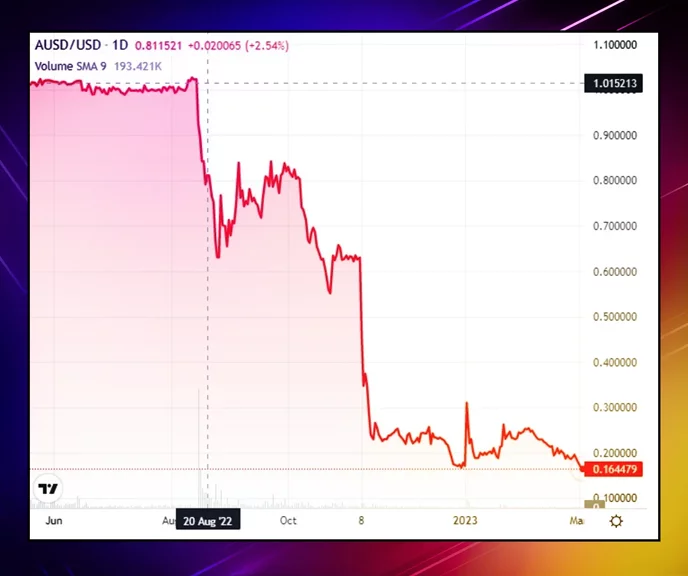
Acala USD
Another example of a failed algorithmic stablecoin is Acala USD. Backed by the governance token ACA, aUSD experienced an inflation bug that minted billions of stablecoins without any collateral.
Though aUSD quickly regained its peg, the fundamental problem still persists. In case a similar situation occurs, the lack of a redemption mechanism will prevent users from redeeming the value in a bank run.
What May Go Wrong with Bridges?
Cryptocurrency bridges may also fail and lead to severe money losses.
Thus, the aforementioned Wormhole bridge fell victim to hackers’ attacks because of an error in the code. Another case of a similar hack refers to an ETH-BSC bridge Qubit that lost about $80 million worth of crypto in January 2022.
Yet, these are not the most interesting cases.
Better attention during the development process combined with external security audits could bring down the risks of such hacks to a minimum.
What makes blockchain bridges particularly vulnerable is the lack of decentralization. The Ronin Bridge hack, disclosed in March 2022, is the clearest example. Malicious actors gained control of five of the nine validator nodes and drained approximately $625 million in ETH and USDC. The attack succeeded because the bridge’s security model depended on a small number of trusted validators rather than a large decentralized set.
Building a truly decentralized solution with a thorough crypto audit is key to building a secure and scalable blockchain platform. Together with crypto redemption mechanisms, such an approach could become the next step in blockchain development.
How to Choose the Right Redemption Structure
Not every redemption structure fits every investor. Use the questions below to identify which type of crypto redemption applies to your situation.
You hold a fiat-backed stablecoin (USDC, USDT, PYUSD):
Check whether the issuer publishes monthly reserve attestations from a recognized auditor. If yes, and if the issuer is regulated, your redemption risk is primarily issuer solvency. Redemption is typically processed in 1-3 business days.
You hold an algorithmic or protocol-native stablecoin (USDL, DAI, FRAX):
Your redemption is processed by smart contract with no human intermediary. Speed is near-instant. Risk sits in the collateral price and the smart contract code. Confirm that the collateralization ratio is publicly visible on-chain before relying on redemption for a large position.
You hold a crypto ETF or ETP (GBTC, FBTC, spot Bitcoin ETF):
Redemption goes through your broker at the fund’s net asset value. Settlement is T+1 or T+2. In weeks of heavy outflows, NAV can trade at a discount to spot price. If you need to exit during a high-redemption-volume week, the price you receive may differ from what you expect based on spot price alone.
You hold a tokenized fund unit (uMINT or similar):
On-chain redemption infrastructure is new. Confirm that the fund uses a recognized Digital Transfer Agent standard and that your jurisdiction recognizes your redemption right legally. Settlement timelines vary by fund.
The Bottom Line
A redemption mechanism is not a feature. It is the foundation.
Stablecoins, bridge tokens, ETF shares, and tokenized fund units all depend on one thing: the ability to exit at or near the stated value. When that ability breaks, the stated value becomes fiction. UST proved it. The Acala aUSD bug proved it. The $1.7B ETP outflow weeks of 2026 show that even regulated, well-capitalized products face real pressure when redemption demand spikes.
Before holding any pegged or fund-wrapped crypto asset, ask three questions. Can you redeem at any time, or only during defined windows? Is the redemption backed by audited reserves or by an algorithm that depends on its own token price? And who is legally obligated to process your request if something goes wrong?
For protocol-native assets like USDL on the Liquid Loans protocol, the answers are built into the code: fully collateralized, redeemable on demand, with no reliance on a third-party issuer.
Kate

Kate is a blockchain specialist, enthusiast, and adopter, who loves writing about complex technologies and explaining them in simple words. Kate features regularly for Liquid Loans, plus Cointelegraph, Nomics, Cryptopay, ByBit and more.