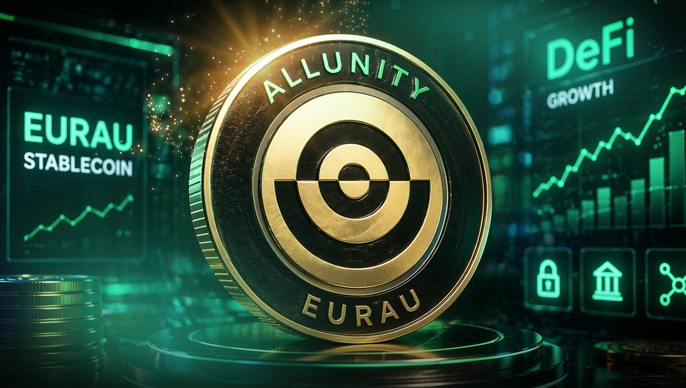
AllUnity is pushing its euro stablecoin EURAU deeper into DeFi. The company’s deploying liquidity pools on major exchanges. That includes Uniswap and Raydium. This comes from an official press release from the MiCA-compliant issuer.
The EU’s trying to challenge dollar-pegged stablecoins. They dominate the market. Roughly 97% of the $316 billion global stablecoin market. That’s massive.
The expansion includes new trading pairs. EURAU with USDT on Ethereum and Solana. Also EURAU/USDT0 on the Tempo blockchain. That’s according to AllUnity. These integrations build on the stablecoin’s December 2025 debut on Aerodrome. Its first decentralized exchange listing. EURAU launched in July 2025. It remains considerably smaller than leading euro-denominated stablecoins.
“The expansion into decentralized exchanges aims to create a euro liquidity layer,” an AllUnity spokesperson said in the official press release.
The company holds a BaFin e-money license. It operates under the EU’s Markets in Crypto-Assets Regulation. MiCA’s the bloc’s sweeping framework. Designed to bring order to digital asset markets.
AllUnity’s strategy highlights tensions within that framework. The company’s explicitly pairing EURAU with major dollar stablecoins like Tether’s USDT. They’re creating cross-currency infrastructure. That may test regulatory boundaries.
MiCA was partly crafted to reduce reliance on U.S. dollar assets in European crypto markets. But how will regulators respond to tight interoperability between compliant euro tokens and non-MiCA dollar stablecoins? That remains uncertain.
The European Central Bank has questioned whether many decentralized autonomous organizations are genuinely decentralized enough to escape regulation. That’s according to European Commission documents. DeFi platforms generally fall outside MiCA’s direct scope. But that ambiguity creates challenges for issuers like AllUnity. They’re navigating both regulated and permissionless environments.
“MiCA seeks to balance the stablecoin landscape against the US dollar dominance,” according to European Central Bank official commentary.
The regulation’s rollout has been rocky. Some issuers have declined to pursue EU compliance. Notably Tether. They’ve faced subsequent delistings from regulated exchanges as a result.
AllUnity’s cross-chain liquidity push spans Ethereum and Solana. Two of DeFi’s busiest ecosystems. Can the strategy carve meaningful market share for euro-pegged assets in a dollar-dominated landscape? How will EU authorities respond to euro-dollar interoperability?
These questions will test both the issuer’s ambitions and MiCA’s practical reach into decentralized markets.