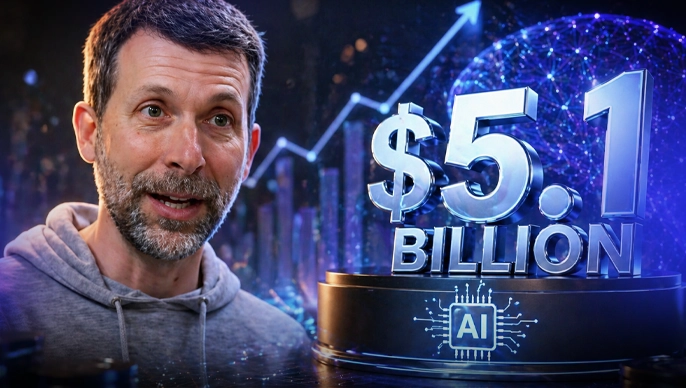

David Silver just launched a new AI company. It’s called Ineffable Intelligence. The funding? $1.1 billion. The valuation? $5.1 billion already.
Silver’s the AI researcher behind DeepMind’s AlphaGo program. That’s the one that famously defeated the world Go champion. Now he’s going after artificial superintelligence. His method: reinforcement learning. Not traditional training on human data.
He’s got a striking analogy for this. Human data is “fossil fuel,” according to the company’s press release. It gave AI a powerful boost. But it’s finite. Self-learning systems? Those are “renewable fuel.”
The distinction matters. Silver put it directly: “LLMs trained only on text risk reproducing collective human errors.” – he told Wired.
His track record speaks for itself. AlphaGo mastered complex strategic thinking without relying on human gameplay examples. The system played millions of games against itself. It discovered strategies human players had never conceived.
Ineffable Intelligence wants to apply those same principles. The goal: AI systems that learn and adapt autonomously. No scraped internet text. No human-labeled datasets. Just trial and error in controlled environments.
This could sidestep some major limitations. Current large language models amplify biases in their training data. They reproduce errors. Self-learning systems might avoid that trap.
The $1.1 billion funding round is massive. It puts Ineffable Intelligence among the most heavily capitalized AI startups. The announcement didn’t disclose investors. But that $5.1 billion valuation tells you something. There’s growing interest in alternative approaches to AI development.
The industry’s grappling with real problems. Data availability. Copyright concerns. Some researchers think traditional models are hitting a plateau.
Silver’s vision goes beyond incremental improvements. He’s betting big. Reinforcement learning as the primary pathway to superintelligence. Autonomous learning systems will prove more capable than models trained solely on human content. That’s the thesis.
Can it deliver? We don’t know yet. But the substantial backing suggests investors are willing to fund the experiment.