
Have you ever observed an insignificant amount of cryptocurrency in your digital wallet that you could not recall receiving?
Initially, you might have been exhilarated, presuming that someone had accidentally transferred funds to you.
However, the truth is that you may have become the victim of a Crypto Dust Attack, and if you fail to take necessary precautions, you may lose money.
This article will shed light on the intricacies of crypto dusting attacks, delineate the parties that may be vulnerable to such an attack, and suggest measures to mitigate such malicious activities.
What is Crypto Dust?
In order to send crypto you have to pay a network fee. The size of this fee usually depends on the current level of network congestion. For example, during peak congestion in April 2021, Bitcoin transaction fees reached approximately $62.8 per transaction according to BitInfoCharts. Fees fluctuate significantly based on network demand. By contrast, proof-of-stake networks like Solana or TRON typically charge a fraction of a cent per transaction.
Regardless of the network, the fees hardly ever represent a rounded number. Thus, when you send all your crypto to someone else, you will usually find some small leftovers in your wallet. This is exactly what the term dust refers to.
This phenomenon is possible thanks to crypto divisibility, one of the key technical aspects that make cryptocurrencies stand apart from traditional fiat money. It means that cryptocurrencies can divide into much smaller units than US dollars or other traditional money. For example, the smallest Bitcoin unit satoshi equals 0.00000001 BTC.

While this feature can be useful for micro-transactions, it may be used to compromise crypto wallet security.
What is a Crypto Dust Attack?
A crypto dust attack is a tactic used by hackers or spammers to compromise the privacy and security of cryptocurrency users. It involves sending tiny amounts of cryptocurrency (referred to as “dust”) to a large number of crypto wallets in order to track and potentially link the addresses together.
The dust is usually sent in a way that is difficult for the user to notice, often as small amounts of a few satoshis (the smallest unit of Bitcoin). Once the dust is received, it can be used to track the recipient’s activity on the blockchain, potentially revealing personal information and transaction history.
In addition to tracking, dust attacks can also be used to spam users with unwanted transactions or to clog up the network with small, useless transactions. These attacks are often carried out using automated scripts or bots, making them relatively easy and cheap to execute.
If you have ever received one or many small incoming crypto payments to your wallet, you may have been dusted. While the dust itself doesn’t bear any harm, it may help attackers if you start moving it around.
Typically, crypto dust attacks pursue different goals depending on the asset type.
Dust Attack Risk: UTXO-Based vs Account-Based Blockchains
👉 Quick takeaway: UTXO-based chains like Bitcoin risk address clustering if dust is spent; account-based chains like Ethereum face greater risk from malicious token approvals than from dust itself.
| Factor | UTXO-Based (e.g. Bitcoin) | Account-Based (e.g. Ethereum, TRON) |
|---|---|---|
| How funds are stored | As individual unspent outputs | As a single balance per address |
| Primary attack goal |
Link multiple addresses to one owner via co-spending ⚠️ Address clustering risk |
Deliver phishing links or malicious token approvals via transaction metadata ⚠️ Approval exploit risk |
| Risk if dust is ignored |
🟢 Low Dust stays as an isolated UTXO |
🟢 Low But malicious token contracts can still request approvals |
| Risk if dust is spent |
🔴 High Co-spending reveals address clusters |
⚠️ Medium Activity is visible but address linking is less direct |
| Best defense |
Coin control, HD wallet, avoid consolidating UTXOs 🏆 Coin control is most effective |
Ignore unknown token transfers, revoke suspicious token approvals 🏆 Revoke.cash for approval management |
| Privacy tools available | CoinJoin, new address per transaction | Privacy coins, mixer protocols (jurisdiction-dependent) |
For Bitcoin users, the UTXO model makes dust attacks particularly effective because every spent output is permanently recorded and linkable. For Ethereum users, the greater risk is often malicious token contracts that arrive alongside dust and request wallet approvals.
What Should You Do If You Receive Dust?
If you spot an unknown micro-transaction in your wallet, use this framework before taking any action:
Step 1 – Identify: Is the incoming amount so small it cannot cover a standard transaction fee on that network? If yes, treat it as potential dust.
Step 2 – Do not move it: Do not spend, consolidate, or transfer the dust amount alongside your other funds. Co-spending dust with your legitimate balance is what gives attackers the data they need.
Step 3 – Check your wallet settings: Many modern wallets (such as those with coin control features) allow you to mark a UTXO as ‘do not spend.’ Enable this if available.
Step 4 – Use a fresh address: For your next legitimate transaction, generate a new receiving address rather than reusing one that received dust.
Step 5 – Report or flag: Some wallets allow you to flag suspicious incoming transactions. Use this feature so the dust stays isolated in your transaction history.
If none of these options are available in your current wallet, consider migrating to an HD (hierarchical-deterministic) wallet that generates a new address per transaction automatically.
What Does Crypto Dust Attack Look Like?
Crypto dusting is a small amount of crypto that comes from an unknown address. It may be a single transaction or it may be a series of transactions performed within a period of time.
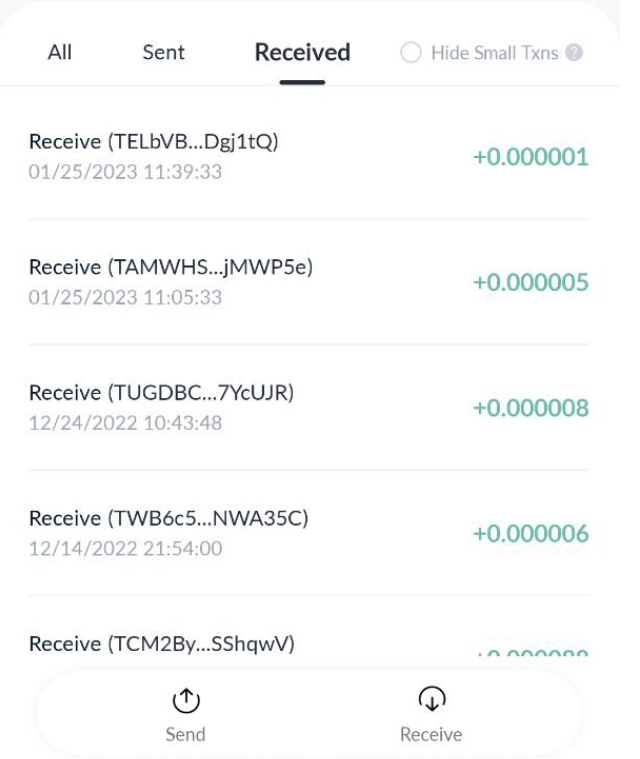
A crypto dust attack in a TronLink wallet
How Does a Crypto Dust Attack Work?
Crypto dusting typically involves sending small amounts of crypto to many addresses, often without targeting any single person specifically.
Here is how the attack unfolds in practice:
- The attacker identifies a list of active wallet addresses, often sourced from public blockchain data or exchange withdrawal records.
- Tiny amounts of crypto (dust) are sent to each address using automated scripts. The amounts are small enough to avoid notice but large enough to register as a valid on-chain balance.
- The attacker then deploys specialized blockchain analysis software to monitor every wallet that received the dust.
- A wallet that never touches the dust stays isolated. A wallet that spends or consolidates the dust alongside other funds creates a transaction trail.
- By observing which addresses appear together in the same outgoing transaction, the attacker can infer that those addresses belong to the same person or entity.
- This address map can then be cross-referenced with exchange withdrawal records, IP data, or known wallet labels to attempt to link the addresses to a real-world identity.
The key vulnerability is co-spending: the moment you include dust in a transaction alongside your legitimate funds, you have connected those two address histories on the public ledger. Blockchain data is pseudonymous, not anonymous, and this transparency is exactly what dusting exploits.
A Real-World Example of Address Linking
Here is a simplified illustration of how address linking works in practice:
- You hold funds across three Bitcoin addresses: Address A (0.5 BTC), Address B (0.3 BTC), Address C (0.2 BTC).
- An attacker sends 546 satoshis (roughly $0.003 at typical Bitcoin prices) to all three addresses.
- You later consolidate your funds into a single address, combining outputs from Address A, B, and C in one transaction.
- The blockchain now permanently records that Address A, B, and C were all used as inputs in the same transaction, confirming they belong to the same wallet owner.
- If Address A was ever used on an exchange that collected your identity, the attacker can now link Address B and C to your real-world identity as well.
This is why consolidating small UTXOs, a common practice to tidy up a wallet, is the exact behavior dust attacks are designed to provoke.
Who Performs Crypto Dusting Attacks?

Crypto dust transactions require network fees, just like any other transaction on the blockchain. At this, sending dust to thousands of addresses may cost a fortune, especially when an attacker performs dusting on Bitcoin or other expensive networks.
Who would go to such extremes? Essentially, there are a few key groups.
1. Criminals
Malicious actors may use crypto dusting while looking for a big fish in the ocean of smaller targets.
Crypto dust attacks may help such criminals identify large crypto holders in the list of regular crypto users. Having revealed potential victims, criminals may elaborate phishing attacks or perform other malicious activities aiming to steal digital assets.
Alternatively, a large criminal gang may try to hide its own traces. In this case, crypto dust acts as a smoke screen helping criminals to spread the dirty money and throw the watchdogs off the trail.
2. Blockchain companies
The companies may use mass crypto dust as a stress test for their own networks. Thus, crypto dusting helps them to test the throughput indices. Alternatively, they may attack their competitors aiming to spam their networks and slow them down.
In addition, crypto companies may send out crypto dust in a form of free airdrops. Such airdrops may even bear real value. The goal of such an attack is to get users interested and to reveal themselves by moving these tokens across exchanges.
3. Authorities
Governmental financial structures may use crypto dusting to identify people or a group of people linked to a specific address. Thus, they may reveal large criminal networks, gangs, tax evaders, or those engaged in money laundering.
4. Analytical companies
Such companies perform crypto dusting as they pursue academic goals while studying various aspects of blockchain networks.
Interestingly, you don’t have to conduct a crypto dust attack yourself in order to use the information it reveals.
Imagine there has been a crypto dusting attack that gained some traction in the large media. Governments as well as analytical companies may identify the scope of this attack and use the information for their own purposes without spending any money.
4. Blockchain companies
The companies may use mass crypto dust as a stress test for their own networks. Thus, crypto dusting helps them to test the throughput indices. Alternatively, they may attack their competitors aiming to spam their networks and slow them down.
In addition, crypto companies may send out crypto dust in a form of free airdrops. Such airdrops may even bear real value. The goal of such an attack is to get users interested and to reveal themselves by moving these tokens across exchanges.
How to Counter Crypto Dust Attacks?
Protecting yourself from crypto dusting is not rocket science. With a diligent approach to the security of your digital assets, there’s nothing you should fear.
Here are some tips that can help secure your funds in case you received crypto dust:
1. Do not co-spend dust with your legitimate funds.
This is the single most important rule. The attack only succeeds when dust appears in the same outgoing transaction as your other funds. If you never spend the dust, attackers gain no linking data.
2. Use coin control to freeze dust UTXOs
Many Bitcoin wallets (including Electrum and Sparrow Wallet) offer a coin control feature that lets you manually select which UTXOs to include in a transaction. Mark received dust as ‘do not spend’ to prevent accidental co-spending.
3. Use hierarchical-deterministic (HD) wallets.
HD wallets generate a fresh receiving address for every transaction automatically. This limits how many transactions can be linked to a single address and reduces the effectiveness of address clustering.
4. Consider CoinJoin for Bitcoin transactions.
CoinJoin is a privacy technique that combines multiple users’ Bitcoin transactions into a single transaction, making it harder to trace which inputs belong to which user. Wallets like Wasabi and JoinMarket support this natively.
5. Isolate dust on a separate wallet.
If you want to preserve the dust without risk, transfer it to a completely separate wallet that has no connection to your main holdings. This prevents any accidental consolidation.
6. Revoke suspicious token approvals (Ethereum and EVM chains).
For account-based networks, dust is sometimes accompanied by malicious token contracts that request wallet approvals. Use a tool like Revoke.cash to audit and revoke any approvals you did not intentionally grant.
7. Follow general security hygiene.
- Do not click links in transaction memos or descriptions from unknown senders.
- Do not interact with unverified tokens.
- Do not share information that could connect your identity to your wallet address.
Frequently Asked Questions About Crypto Dust Attacks
Can a dust attack steal my crypto?
No. Dust attacks do not give attackers access to your private keys or wallet funds. The attack is purely an information-gathering tactic aimed at reducing your privacy, not stealing your assets.
How much crypto counts as dust?
On Bitcoin, dust is typically defined as any UTXO whose value is less than the fee required to spend it. For most other networks, any amount too small to be economically meaningful in a transaction can be considered dust. There is no universal threshold across all blockchains.
Will my wallet automatically protect me from dust attacks?
Some modern wallets automatically flag or isolate tiny incoming transactions. HD wallets reduce risk by generating new addresses per transaction. However, no wallet eliminates the risk entirely without user awareness and coin control habits.
Is a dust attack the same as an airdrop?
Not exactly. Legitimate airdrops distribute tokens with real value as a marketing tactic. Dust attacks use similarly tiny amounts but with the intent to track wallet activity. Some malicious actors disguise dust attacks as airdrops to encourage recipients to interact with the tokens.
Do dust attacks work on privacy coins like Monero?
Dust attacks are significantly less effective on privacy-focused networks like Monero because transaction amounts, sender addresses, and receiver addresses are obfuscated by default. This is one reason privacy coins are sometimes recommended for users with heightened anonymity needs.
Bottom Line
For most everyday crypto users, a dust attack is a low-risk event if handled correctly. The dust itself does not expose your private keys, drain your wallet, or reveal your personal information on its own.
The risk becomes real the moment you co-spend dust with your legitimate funds. At that point, blockchain analysis tools can link your addresses together, and if any of those addresses are connected to an exchange account with identity verification, your real-world identity may be traceable.
High-value holders, privacy-sensitive users, journalists, activists, and anyone operating in a region with strict financial surveillance should treat any unexplained micro-transaction as a potential dust attack and apply the defenses outlined above.
The good news: a wallet that never touches its dust stays protected. Awareness and a few deliberate wallet habits are all it takes to neutralize this type of attack entirely.
Kate

Kate is a blockchain specialist, enthusiast, and adopter, who loves writing about complex technologies and explaining them in simple words. Kate features regularly for Liquid Loans, plus Cointelegraph, Nomics, Cryptopay, ByBit and more.
Leave a Reply